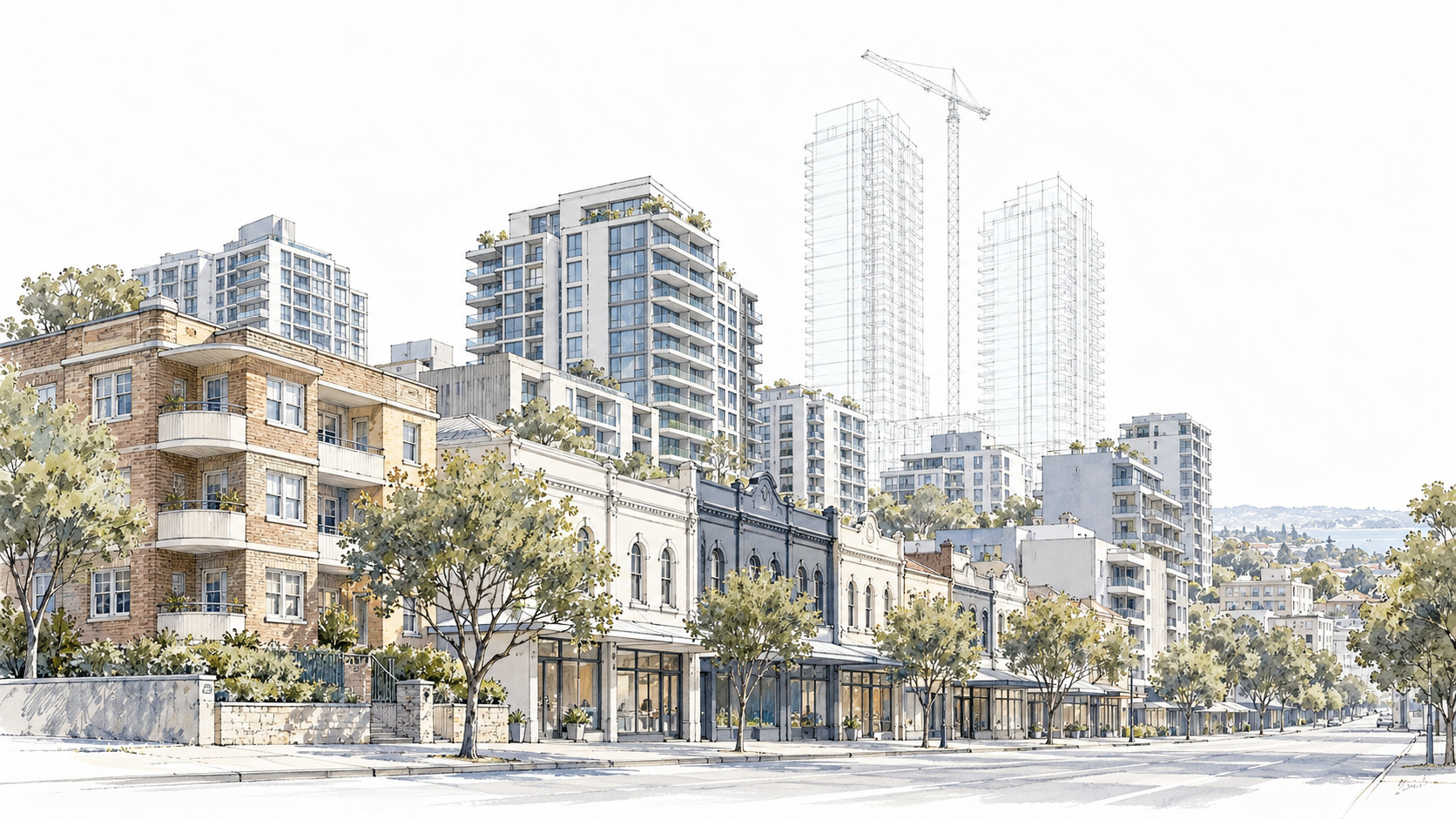
Bondi Junction · Investor briefing
Bondi Junction’s planning divide, and what it means for the landlord down the street
Council and Macquarie Street are arguing about heights and housing targets. Meanwhile, more than a thousand rental apartments are sitting in the state pipeline. If you own an investment unit here, that is the number to watch.
1,042build-to-rent apartments in one State Significant application on Oxford Street3,000new homes in the master plan Council adopted in July, now paused2.2vacant weeks that cancel out a $50 a week rent cut on a $1,200 unitMost of the noise about Bondi Junction is about towers and who gets to approve them. The question I keep getting from owners is simpler. If a lot of new rental stock lands near my unit, what happens to my rent?
The planning fight matters. It decides heights, infrastructure and how fast new housing comes. But for anyone holding an investment apartment here, it flows straight through to rent, vacancy and what you’ll need to spend to stay competitive.
I’ve been selling and leasing in the Eastern Suburbs since the mid-1980s. I’ve seen supply waves before. Good planning lifts a suburb. A rush of new stock can still leave individual owners exposed. Both things can be true at once, and this article is about holding both in your head.
The planning fight
A plan adopted on a casting vote, then paused on a coin toss
Waverley Council adopted the Bondi Junction Master Plan on 21 July. It allows for about 3,000 new homes, 10 per cent affordable, plus 9,000 square metres of extra public space. The vote was tied. The then mayor, Will Nemesh, used his casting vote to carry it.
Eight weeks later the council chose a new mayor. Councillors split six all, and Steven Lewis won the random ballot. He had opposed the plan in July. On the night he announced he would pause its implementation and go back to residents, businesses and stakeholders. He has said the plan won’t be scrapped.
The state is not standing still. Premier Chris Minns said the day after the vote that government and councils have to keep going with new housing. The state pathway that carries the big Oxford Street rental towers sits outside Council’s pause altogether.
Jul 2025900 rental units proposedHousing Delivery Authority backs a three-tower build-to-rent scheme on Oxford Street for the state pathway.
May 2026Draft plan on showCouncil exhibits the master plan. More than 800 submissions follow.
21 Jul 2026Adopted on a casting vote3,000 homes, 9,000 m² of public space, a new civic precinct.
15 Sep 2026New mayor, plan pausedSteven Lewis wins a random ballot after a 6–6 tie and pauses implementation.
Now1,042 rental units in the systemThe build-to-rent proposal sits at environmental impact statement stage.
Sources: ABC News, 22 Jul 2026; Australian Financial Review, 17 Sep 2026; NSW Housing Delivery Authority record of briefing, 15 Jul 2025; NSW Planning Portal.
Build-to-rent
One landlord, a thousand front doors
Build-to-rent means one owner keeps every apartment and leases them all. No individual investors. One operator, one leasing campaign, one set of incentives.
The scheme on Oxford Street, either side of the mall near the station, is listed on the NSW Planning Portal as 1,042 build-to-rent apartments across three buildings of 37 to 45 storeys, with 10 per cent of floor space set aside as affordable housing. The first building has its own listing: 345 apartments at 410–420 Oxford Street. Both sit at “prepare EIS” stage. That is a long way from approval.
The scheme has grown. When the Housing Delivery Authority first looked at it in July 2025 it was 900 apartments in three 36-storey towers. The authority warned that a proper assessment might bring the numbers down. Even so, the direction so far has been up.
Don’t add this figure to the master plan’s 3,000 as if they were separate. Some of it may overlap. Don’t count it as next year’s supply either. Nothing here has a confirmed start date.
The Oxford Street build-to-rent scheme
Proposed apartments, as lodged at each stage
Expression of interestHDA briefing, Jul 2025900Current combined listingPlanning Portal, three buildings1,042First building only410–420 Oxford St34502755508251,100The first building is part of the 1,042, not extra to it. Source: NSW Planning Portal, SSD-100907461; HDA record of briefing, 15 Jul 2025.
Already being built
Three projects closer to home, and what their numbers don’t tell you
The rental towers are years off at best. Three other projects are much closer, and all are still selling.
New apartments in or near the Bondi Junction core
Total residences per project, drawn to one scale
Oxford St build-to-rentProposed1,042Signature, 362–384 Oxford StUnder construction118Origami, 55 Grafton StUnder construction88The Centennial Collection, 2 Nelson StUnder construction8502755508251,100Proposed, not approvedApproved and building118Two 14-storey buildings, mostly one and two bedrooms, from $1.495 million. Ray White Projects reported 25 per cent sold before the public launch in March. That figure is old. It can’t tell you how many remain today.
88Domain lists 88 residences and late 2026 completion, subject to change. Other listing sites still show an earlier figure of 106. I’ve used the developer’s current Domain number.
85Marketed at launch as 73 residences with completion late 2025. NSW Planning later approved extra height through the state pathway, taking the approval to 85 apartments, 17 of them affordable. Listings are still live.
None of these totals is a rental count. Some buyers will live in their apartments. Some will lease them out. A developer may hold unsold stock and rent it. Nobody publishes how that will split, and I’d rather say so than invent a supply figure that sounds alarming.
The rental market today
Busy now. That isn’t the same as ready for more.
92units advertised for rent in the past month712units leased over the past 12 months20median days a rental was advertised$1,200median weekly rent, two-bedroom unitrealestate.com.au Bondi Junction suburb profile, two-bedroom rent for Oct 2025 – Sep 2026. Figures as captured on 23 October 2026.
Those numbers describe a healthy leasing market. Units are moving in about three weeks. Rents are firm.
But look at what each figure actually measures. Advertised stock, vacant stock and a year’s worth of leases are three different things. None of them tells you whether the suburb could take several hundred extra apartments without existing owners feeling it.
Real Estate Investar shows a vacancy rate of 2.41 per cent. Its public page doesn’t say which month that covers or how it’s worked out, so I treat it as a guide only. I haven’t yet checked it against CoreLogic or the REINSW vacancy survey.
My read: the market is fine today. The question is what happens when a lot of new stock arrives in a short window.
How the pressure travels
The risk is timing, not just size
Supply that trickles in gives demand time to catch up. Several big buildings leasing up within a year or two is a different story, especially for similar units close by.
Some new tenants will come from outside the suburb. Others will move out of older local rentals. Their old landlords then need someone new. That’s how the pressure spreads, one move at a time.
I’m not forecasting that rents will fall. Jobs, migration, household formation and what the new buildings actually charge will all shape demand. I’m saying owners should know how this chain works so they recognise the early signs.
- 1A new building starts leasingFresh fit-outs, launch incentives, a big marketing push.
- 2Nearby tenants trade upSome leave older units close by when their lease ends.
- 3Older stock feels itFewer enquiries first. Longer to lease next. Rent pressure last.
Competing with new
New doesn’t automatically win
An established unit can have bigger rooms, better light, a car space, a quieter aspect or simply a sharper rent. Those things only count if a tenant sees them at the inspection.
Where owners get caught is a tired apartment asking a premium price. Once tenants have shiny alternatives a few blocks away, that gap shows. Presentation, maintenance and a property manager who answers the phone start to matter a lot more.
If you’re already carrying higher levies, a special levy for building works, or a big mortgage, a few extra empty weeks hit cash flow fast.
Run your own numbers
Vacancy usually costs more than a modest rent cut
Holding out for the top figure feels like the safe call. Often it isn’t. Move the sliders to your own unit. The example starts at $1,200 a week, four empty weeks and a $50 reduction.
+$2,200a year better off by taking $50 less and letting it now, compared with four empty weeks at full rent.
Annual gross rent, three scenarios
Before expenses, fees and reletting costs
Full rent, never vacantThe best case$62,400Hold out, then leaseFull rent, 4 weeks empty$57,600Cut and let now$1,150 for 52 weeks$59,800Break-even: about 2.2 empty weeks. Any longer than that and the rent cut wins.
Illustration only. It ignores agent fees, advertising, letting fees and any rent-free incentive. Your asking rent should still come from current comparable leases.
What I’d do now
Six things to check before the cranes arrive
Ask for achieved rents, not asking rents, on comparable units leased in the last three months.
Find out how long they took to lease and whether the owners had to drop the price to get there.
Read your building’s sinking fund forecast and the last two AGM minutes. Know what levies are coming.
Stress-test your cash flow against four empty weeks and against a $50 a week cut. Use the calculator above.
Fix what tenants notice. Paint, lighting, blinds, a tired kitchen front. Spend in proportion to the rent it protects.
Look after a good tenant. Prompt repairs and a fair renewal offer usually beat chasing an extra $20 a week.
My view
Bondi Junction will probably be a better place in ten years. Better squares, better links, more life after dark. A better suburb and a harder leasing year can arrive at the same time.
A housing target tells an investor very little. What matters is what actually gets built, when it opens and which tenants it goes after. My worry is narrow and practical. New rental stock could arrive faster than the matching demand, and some owners won’t have the buffer to ride out longer vacancies.
Council and the state will settle their differences eventually. Your own position is something you can check this week.
If your tenant had a lot more choice, why would they pick your apartment, and what would they pay for it?
Alan WeissPrincipal, Weiss Real Estate · 0412 176 074For a review of your investment apartment, where its rent sits and what competing supply is coming, call me directly.
Sydney Buyers Are Negotiating Harder—But Some Eastern Suburbs Homes Still Stand Out
Sydney buyers now fear overpaying more than missing out. Alan Weiss on what that means for Eastern Suburbs sellers, upsizers and repayments in 2026.