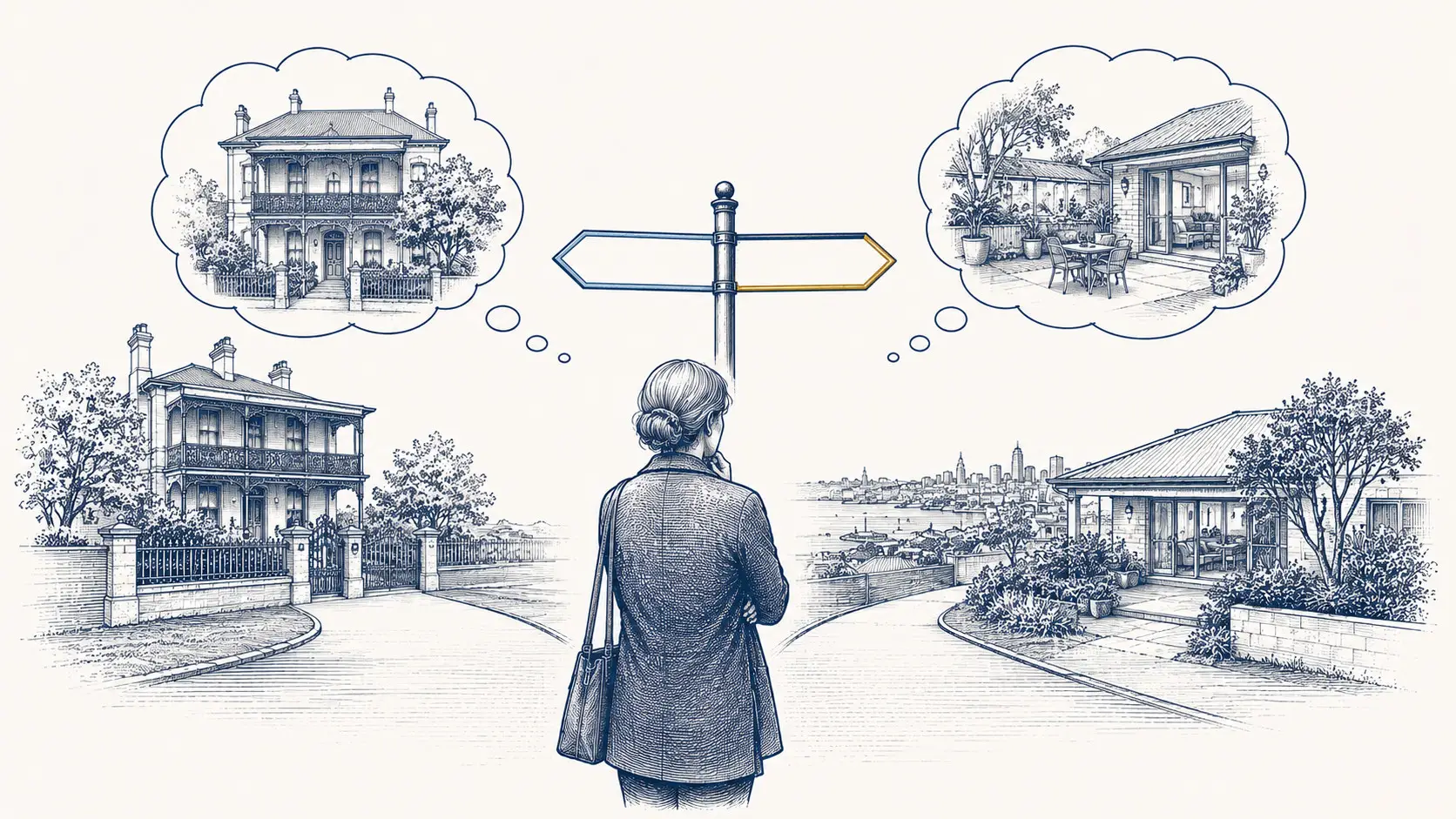
Downsizing is a choice, not an assumption
Downsizing is often treated as a foregone conclusion the moment the children leave. It shouldn’t be. A clear-eyed way to separate the move that frees you from the one you’ll quietly regret.
There is a particular kind of pressure that settles on a house once the last child has gone. The rooms feel larger than they did. People begin to ask, gently at first, whether it isn’t all a bit much now. And somewhere in that, downsizing stops being a question and becomes an assumption — something one simply does, at a certain age, in a certain stage of life.
In thirty-five years I have helped a great many people downsize, and it has almost always been the right move. But not always. And the difference rarely comes down to the house. It comes down to whether the decision was made clearly, or simply drifted into. That has never mattered more than it does now. A market that has turned — Sydney values fell 3.2 per cent over the June quarter on Cotality’s numbers, the Reserve Bank has lifted rates three times this year on the back of an offshore energy shock rather than anything in our own economy, and the tax rules are still unsettled after the May Budget — pushes people toward two opposite mistakes: rushing to sell before prices slip further, or freezing until the world feels certain again. Both are the same error in different clothes. Both are drift. So before you list anything, I would ask you to sit with three honest questions.
Is it the house, or the stage of life?
A large home can feel like a burden for reasons that have nothing to do with its size. Maintenance you have stopped enjoying, stairs that have started to matter, a garden that has become a chore rather than a pleasure. Those are real, and downsizing answers them well. But sometimes what feels like too much house is really a season that has changed — and a smaller home in the wrong place can deepen that feeling rather than relieve it. Be honest about which one you are solving for.
What does the move actually free — and at what cost?
People tend to picture the capital a downsizing move releases and stop there. But the move itself is not free. Between the cost of selling and the stamp duty on what you buy, an Eastern Suburbs move can shed a six-figure sum before you have unpacked a box — I set out the full arithmetic in a separate piece. If the equity you would free is modest, those costs can quietly swallow much of the benefit. And timing now bears on the sum itself: in a rising market a buoyant sale price hides that arithmetic, but in the market we have — where houses have led the falls while apartments have held up better — the amount you actually free can be smaller, and less certain, than the figure in your head. The research bears the wider point out: studies by the Australian Housing and Urban Research Institute find that older Australians tend to downsize in response to a life event — a change in health, the loss of a partner, the departure of children — rather than as a freely chosen financial strategy. The reason matters as much as the maths.
The question is never whether you can downsize. It is whether the smaller life is one you would actually choose, on a good day, not just tolerate on a tired one.
Where would you rather wake up?
This is the question I find people have asked themselves least, and it is the one that matters most. Strip away the spreadsheet for a moment. Picture the morning. The light, the walk to the coffee you like, the friends within reach, the room you would sit in to read. If the smaller home in the right pocket of the Eastern Suburbs is genuinely a life you would choose — not merely a sensible reduction — then the rest is logistics, and good ones at that. When the wider world is loud — and just now, with rates high and the global outlook uncertain, it is — this is the one question whose answer does not move with the headlines.
When the answer is yes
For most people who work through those questions, the answer is still yes — and arriving at it clearly, rather than under pressure, changes everything that follows. You buy with intent rather than relief. You hold out for the right apartment rather than the available one. You time the sale to your life rather than to a season — and in a market with no rising tide to hurry you, timing it to your life is the only sensible basis left.
I would far rather tell you the move can wait than sell you a home you did not need to leave.
And when the answer is not yet, that is worth knowing too. I would far rather tell you the move can wait than sell you a home you did not need to leave. It is, in the end, the whole point of the way I work.
Work the decision through before you touch the market.
Whether the answer is yes or not yet, it is worth arriving at clearly rather than under pressure. An unhurried conversation, specific to your position — and an honest view of whether the move is one you would actually choose.
The information in this article is general in nature and reflects my own assessment of the Eastern Suburbs market at the time of writing. It is not financial, legal or taxation advice, and figures are drawn from named public sources that may change. Please seek advice specific to your circumstances before making any property decision.