Sydney prices are falling — but the Eastern Suburbs is not one market
House values fell across almost 97 per cent of Sydney suburbs last quarter. For Eastern Suburbs owners, the detail matters far more than the headline.
Sydney’s property downturn has broadened. New realestate.com.au data published on 9 October 2026 found that house values fell across almost 97 per cent of Sydney suburbs over the previous three months, with only six suburbs recording growth. The biggest dollar falls were concentrated on the North Shore, the Northern Beaches — and here in the Eastern Suburbs.
That is the headline. It is also, on its own, close to useless for an individual owner. The same data shows neighbouring suburbs moving in opposite directions, apartments behaving differently from houses, and twelve-month medians telling a different story from the most recent quarter. Treating the Eastern Suburbs as one market has rarely been more misleading.
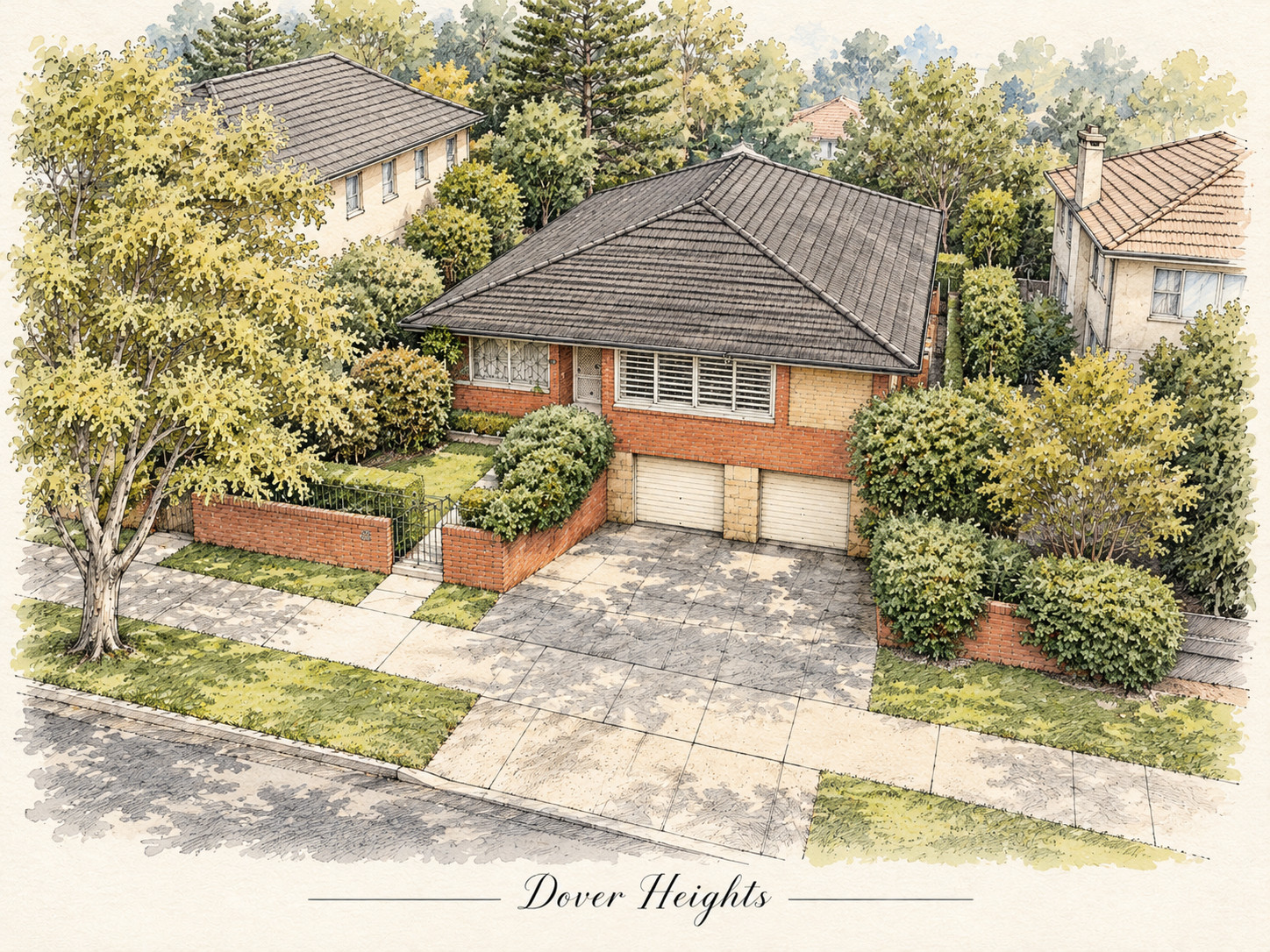
Paddington, Bondi and Dover Heights led the recent falls
The clearest Eastern Suburbs figures in the three-month analysis were Paddington, where the average house value fell by approximately $262,000, or 8 per cent; and Bondi and Dover Heights, where average house values each fell by more than $150,000.
Realestate.com.au did not publish individual three-month figures for every Eastern Suburbs suburb, so it would be misleading to apply the Paddington fall across the entire region. What these figures do confirm is that the softening has reached the east — it is no longer a story about the outer ring.
Apartments have been more resilient than houses
Sydney’s apartment market has also weakened, but less broadly. Unit values fell in 81 per cent of suburbs with available data during the quarter, against almost 97 per cent of house markets. That distinction matters in Bondi Junction, Double Bay, Rose Bay, Bondi Beach and Randwick, where apartments represent a significant share of the local market.
The more volatile the market becomes, the less useful broad Sydney averages become.
What Eastern Suburbs properties are selling for
The suburb profiles offer a second perspective. The figures below are sales medians for the twelve months to September 2026 — a different measure, over a different period, from the three-month valuation movements above.
| Suburb | House median | 12-mth change | Unit median | 12-mth change |
|---|---|---|---|---|
| Tamarama | $9,000,000 | +26.8% | $2,085,000 | −9.7% |
| Vaucluse | $9,500,000 | 0.0% | $1,600,000 | +9.6% |
| Double Bay | $8,325,000 | +25.2% | $2,300,000 | +20.3% |
| Dover Heights | $7,932,500 | +7.9% | $1,625,000 | +92.7%* |
| Clovelly | $6,500,000 | +12.4% | $1,705,000 | −2.3% |
| Rose Bay | $6,400,000 | +21.4% | $1,825,000 | −1.6% |
| North Bondi | $5,310,000 | +7.3% | $1,670,000 | +0.9% |
| Bronte | $5,250,000 | −11.0% | — | — |
| Coogee | $4,600,000 | −0.2% | — | — |
| Bondi Beach | $4,625,000 | +0.5% | — | — |
| Woollahra | $4,250,000 | −17.9% | $1,615,000 | −2.9% |
| Bondi | $4,175,000 | −5.8% | — | — |
| Randwick | $3,750,000 | +3.6% | — | — |
| Paddington | $3,540,000 | −1.2% | — | — |
| Maroubra | $2,900,000 | −4.5% | — | — |
* The Dover Heights unit figure requires particular caution. Only 33 units were recorded as sold over the twelve months, and differences in the type, size and quality of apartments sold can materially move a suburb median. It does not mean an individual Dover Heights apartment rose 92.7 per cent.
Why a suburb can rise over twelve months yet fall over three
This is one of the most important points for owners. Dover Heights carries a twelve-month house median of $7,932,500 — up 7.9 per cent on the previous comparable period — yet the more recent valuation analysis has average house values there falling by more than $150,000 in the latest three months.
There is no contradiction. The figures measure different periods using different methodologies. A twelve-month median can still look strong because it includes transactions from earlier in the year, while the three-month data can show that conditions have since weakened. Relying on a single annual median gives an owner an incomplete picture of what their property could achieve today.
The Eastern Suburbs is not one property market
Perhaps the clearest finding in the data is the gap between neighbouring suburbs. Over the latest twelve-month sales period, Woollahra houses fell 17.9 per cent, Bronte 11.0 per cent, Bondi 5.8 per cent and Maroubra 4.5 per cent — while Rose Bay rose 21.4 per cent, Double Bay 25.2 per cent and Tamarama 26.8 per cent.
These numbers do not mean every Tamarama house rose 26.8 per cent or every Woollahra house fell 17.9 per cent. Medians are shaped by which properties happened to sell — an effect that becomes pronounced in expensive suburbs with small numbers of transactions.
Buyers have less borrowing capacity
There is a broader explanation for the recent weakness. REA Group economist Eleanor Creagh pointed to stretched affordability and higher borrowing costs tempering markets that had previously held firm, and the same report quoted buyer’s agent Rebecca Hall observing that sellers are discovering buyers simply do not have the borrowing capacity they had a year earlier.
In high-value Eastern Suburbs markets, even modest changes in borrowing capacity translate into substantial changes in the dollar amounts buyers are able — or prepared — to offer.
What this means if you are selling
The market has changed. That does not mean every Eastern Suburbs property has suddenly fallen sharply in value. It does mean owners need to distinguish between:
- a suburb median;
- an automated valuation;
- comparable recent sales;
- the condition and position of the property;
- land size or internal apartment area;
- view, aspect, parking and floor level;
- renovation quality;
- strata condition and levies; and
- what buyers are actually prepared to pay today.
A property in Bondi, Bellevue Hill, Rose Bay or Double Bay can perform very differently from another only a few streets away.
The better question is no longer what your suburb rose by last year — it is what buyers are paying for genuinely comparable properties right now.
My view
The Eastern Suburbs market is not falling uniformly. What we are seeing is a far more selective market. Buyers are cautious, borrowing capacity has tightened, and properties priced above current buyer expectations can sit unsold. At the same time, quality properties in tightly held locations are still achieving strong results.
After more than three decades in this market, I have watched this pattern in every cycle: the averages make the headlines, while the real story is written street by street. That is where current market value is found — and it is the only place I look for it.
What would your property achieve in today’s market?
A considered, evidence-based appraisal — comparable sales, current buyer depth and an honest view of timing. No obligation, and no pressure to list.
Request a free appraisal Begin a conversationData note: Figures quoted are sourced from realestate.com.au and its suburb-profile data as available in October 2026. Three-month movements are automated valuation figures and should not be directly compared with twelve-month transaction medians. Markets can vary significantly by property type, bedroom count and individual characteristics. Nothing in this article constitutes financial advice.