There are moments in property where the market moves in cycles.
And then there are moments where the entire structure of a city changes.
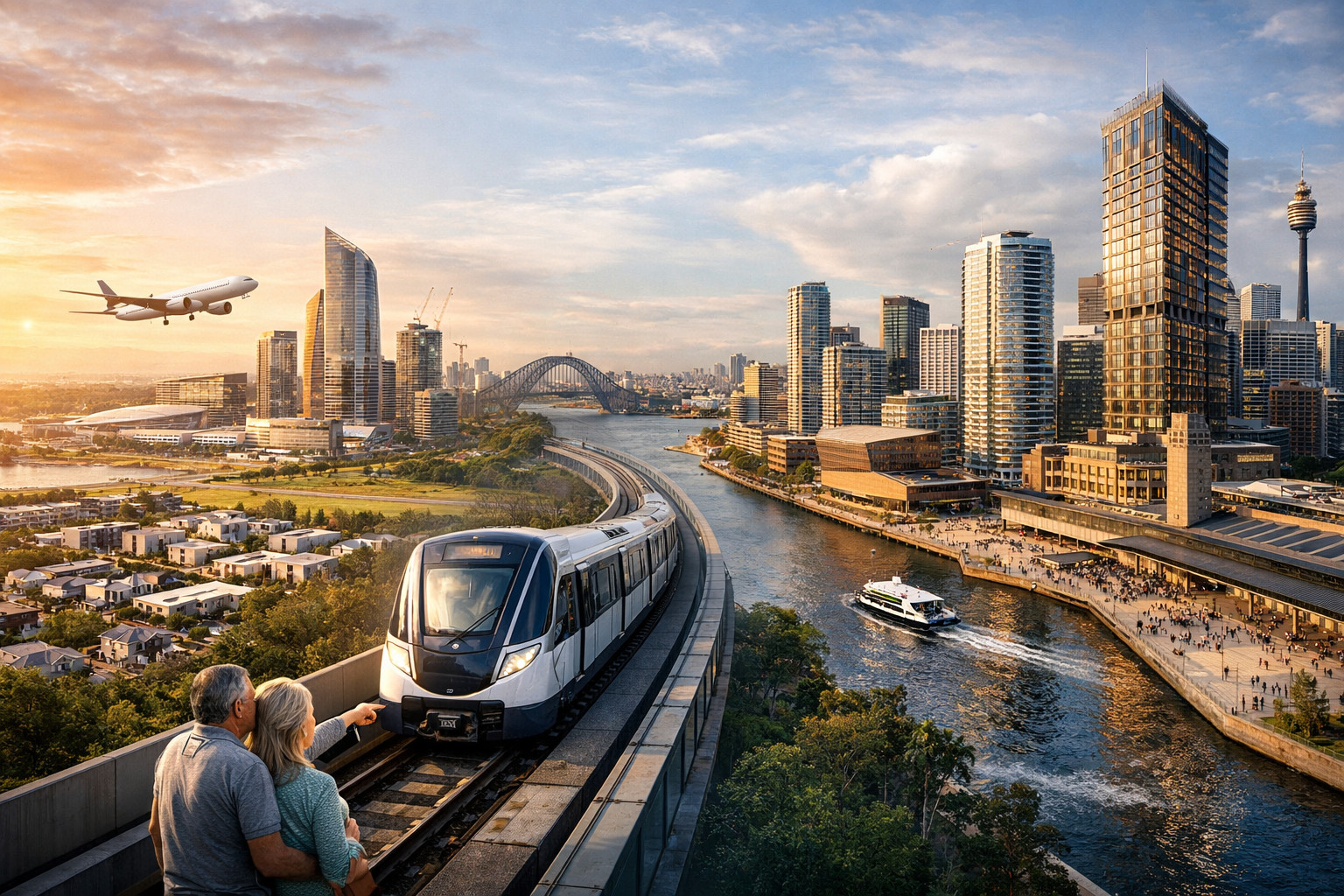
What we are seeing in Sydney right now is not a cycle. It is a structural shift — one that will reshape how people live, where they work, and ultimately where property values are created over the next two decades.
The New South Wales Government has committed well over $100 billion into infrastructure, transport, and urban renewal. But most buyers are still looking at property the way they did ten years ago — suburb by suburb, price by price — without fully appreciating how dramatically the map of Sydney is being redrawn.
If you want to understand where the next wave of growth will come from, you need to step back and look at the city as a whole.
A New City in the West
The most significant change is not happening in the CBD or the Eastern Suburbs. It is happening in Western Sydney.
The Western Sydney International Airport, opening in 2026, is not simply another airport. It is the foundation of a new economic zone — one that will operate around the clock and fundamentally change how Sydney connects to the rest of the world.
Around it, the Aerotropolis is taking shape. This is not a marketing concept. It is a planned economic hub designed to bring together aviation, logistics, advanced manufacturing, and technology. And at the centre of it sits Bradfield — Australia’s first purpose-built city in over 100 years.
What is critical to understand here is that this is a jobs-driven market. People will not move to this area because of lifestyle in the early years. They will move because of employment.
That distinction matters.
It means the early stages of growth will be driven by demand for housing from workers, families, and migrants connected to these industries. Over time, as infrastructure matures, lifestyle follows — and with it, price growth.
We are already seeing early positioning in suburbs like St Marys, Leppington, and Bringelly. What today feels like “outer Sydney” will, in time, feel far more central than many expect.
The Metro Effect — Why Travel Time Now Drives Value
If there is one factor that will define Sydney property over the next decade, it is not interest rates.
It is transport.
The expansion of the Sydney Metro network is changing how buyers think. Sydney is shifting from a distance-based city to a time-based one. Buyers are no longer asking how far a property is from the CBD. They are asking how long it takes to get there.
That shift is already evident.
Suburbs like Five Dock and Burwood North have moved from secondary locations to primary ones, simply because they are being pulled closer to the CBD through infrastructure. The same applies to the Sydenham to Bankstown corridor, where areas like Campsie and Lakemba are transitioning into higher-density urban centres.
This is where we are seeing one of the most interesting changes in buyer behaviour.
Younger professionals and first-home buyers are no longer chasing traditional “blue-chip” suburbs. They are following connectivity. They are buying into future access, not past reputation.
And that is where price growth tends to follow.
The Rise of Parramatta — No Longer a Satellite
For years, Parramatta was described as Sydney’s “second CBD.”
That description no longer feels accurate.
Parramatta is now a fully functioning city in its own right.
With light rail operational, major cultural projects like Powerhouse Parramatta nearing completion, and significant corporate and government presence, the area has reached a level of maturity that changes the property dynamic entirely.
What is particularly interesting in 2026 is the shift in product.
Developers are no longer building generic high-rise apartments. There is a clear move toward better design, larger floorplans, and amenity-rich buildings that cater to long-term living rather than short-term investment.
The buyer profile is evolving as well. More owner-occupiers, more downsizers, and more professionals choosing to live and work in the same area.
That stability is what underpins long-term value.
The Inner-City Transformation — Bays West and Tech Central
While much of the conversation is focused on Western Sydney, there is a quieter transformation happening closer to the CBD.
The redevelopment of the Bays West precinct — including Glebe Island and White Bay — represents one of the most significant inner-city urban renewal projects Sydney has seen in decades. Thousands of new homes will be delivered within minutes of the CBD, effectively creating a brand-new waterfront suburb.
At the same time, the Central Precinct is evolving into what is now being referred to as Tech Central.
This is not just about buildings. It is about jobs — high-value, high-income jobs that attract global talent.
As that happens, surrounding suburbs such as Redfern, Chippendale, and Ultimo are beginning to shift. What were once predominantly student or investor-driven markets are moving toward a more premium, executive-level residential profile.
This is how cities evolve. Employment drives demand, and demand reshapes neighbourhoods.
Infrastructure Beyond Rail — The Missing Piece
Transport is not just trains.
Road infrastructure is playing a critical role in supporting these changes, particularly in Western Sydney. Projects like the M12 motorway, connecting directly to the new airport, are essential in making these new economic zones functional.
Without these connections, growth stalls.
With them, entirely new corridors of accessibility open up.
This is where we start to see secondary suburbs come into focus — places that today may not be on most buyers’ radar but will become increasingly relevant as connectivity improves.
A Different Sydney — And a Different Property Strategy
What all of this points to is a fundamental shift in how Sydney operates.
For decades, property decisions were driven by proximity to a single CBD. That is no longer the case.
Sydney is becoming a multi-centre city.
The CBD will always be important. But it is now just one part of a broader network that includes Parramatta and the Western Sydney Aerotropolis.
Each of these hubs will attract different types of buyers, different price points, and different growth patterns.
And that is where many people get it wrong.
They apply a single strategy to what is now multiple markets.