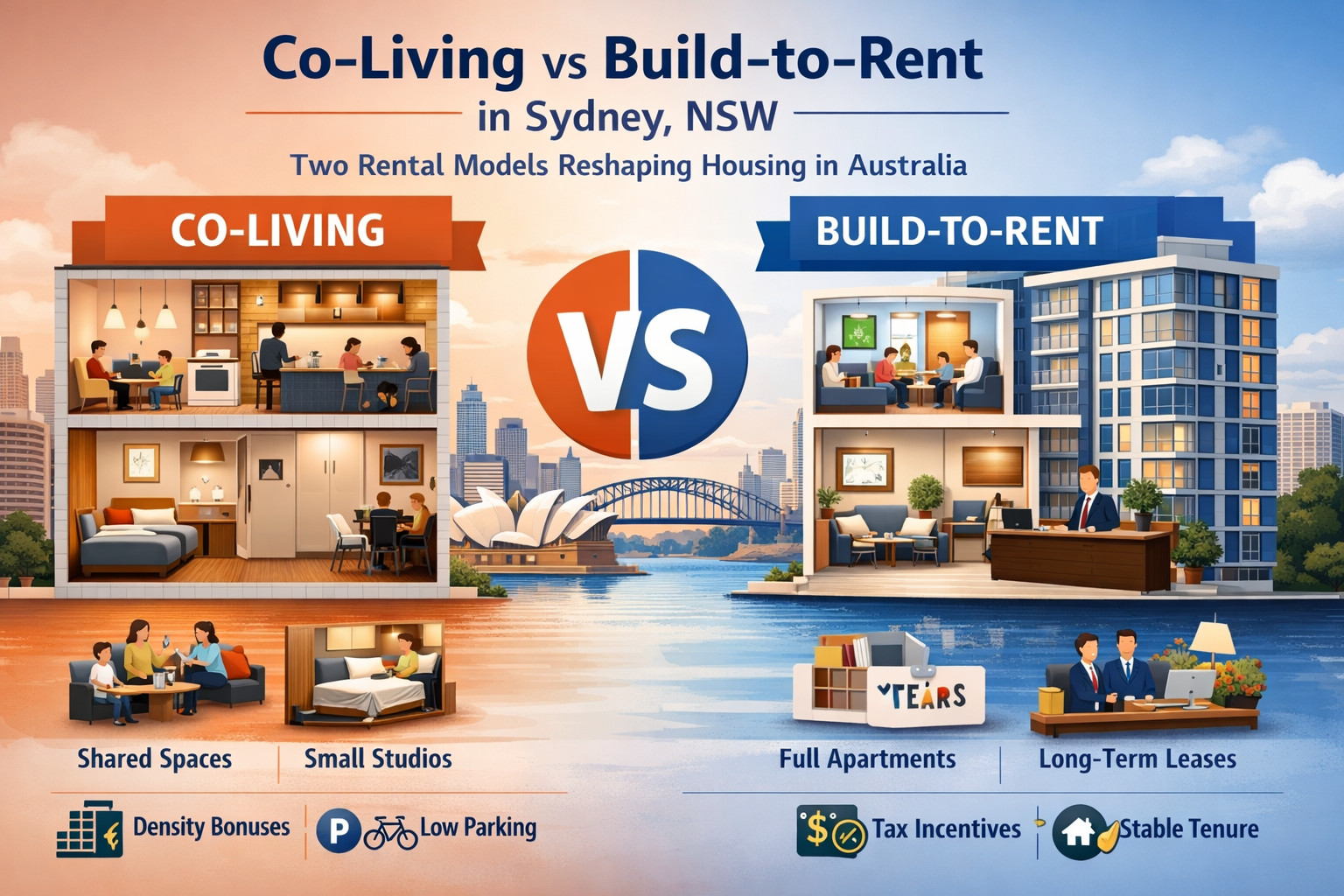
In 2026, the housing conversation in New South Wales has moved well beyond the old question of whether people should rent or buy. A new layer has emerged in the market: professionally delivered rental housing built at scale. Within that shift, two models are standing out — co-living and build-to-rent. They may appear similar from the street, but in reality they are very different products, aimed at different residents, backed by different incentives, and governed by different planning and tax settings.
For renters, the distinction matters because the living experience is not the same. For developers and institutional investors, it matters even more, because the economics, planning uplift, and tax treatment can significantly change the viability of a project. In simple terms, co-living is largely a design-and-density play, while build-to-rent is a long-term ownership and tax-policy play.
What co-living really is
Co-living in NSW is designed as compact rental accommodation built around private rooms and shared spaces. Under the Housing SEPP, co-living must contain at least six private rooms, must provide indoor and outdoor communal areas, must be used as a principal place of residence rather than short-term accommodation, and must operate with a manager responsible for implementing the plan of management who is contactable 24/7. NSW Planning also makes clear that co-living has no mandatory affordability requirement, unlike boarding houses managed by registered community housing providers.
What that means in practice is that co-living is typically aimed at singles, younger professionals, students, key workers, or people who value flexibility, furnished accommodation, and a more social living environment. The private room may be modest in size, but the trade-off is access to shared kitchens, lounges, work areas, and communal amenities that create a more “turnkey” lifestyle. It is often affordable in absolute dollar terms because the private footprint is smaller, even though the rent per square metre can be relatively high.
What build-to-rent really is
Build-to-rent, by contrast, is purpose-built rental housing held in single ownership and professionally managed over the long term. NSW Planning describes it as large-scale rental housing that is professionally managed and retained in one ownership structure, rather than sold off apartment by apartment. These projects are generally made up of standard self-contained apartments — usually one, two, and three-bedroom dwellings — and are designed to offer a more stable, institutional style of rental housing.
The resident proposition is different. BTR is less about shared living and more about long-term renting with better management, stronger tenant retention, and building-wide services. In many cases, the appeal is not simply the apartment itself but the experience around it:
consistent maintenance, on-site management, parcel handling, resident services, and often longer lease terms than the traditional fragmented investor-owned rental market. NSW Planning specifically notes that BTR developers tend to focus on shared facilities and services, with tenants benefiting from longer-term lease security and on-site management.
The real difference: density bonus versus tax shield
This is where the conversation becomes important for developers, investors, and anyone watching the future of Sydney housing.
Co-living is driven by planning uplift
Co-living’s major attraction in NSW is the planning uplift. NSW Planning states that co-living attracts a 10% floor space ratio bonus, while affordable boarding houses receive the larger 30% bonus. In addition, parking settings are materially lighter than conventional apartment developments, with 0.2 spaces per room in accessible areas and 0.5 spaces per room elsewhere. Accessible areas are particularly important because they allow a denser rental product to be delivered close to transport, work, and services.
That is why co-living has become attractive on infill sites where every square metre matters. The model lets a developer produce more rental accommodation on a site than a traditional apartment scheme might allow, while reducing the burden of parking. In a city like Sydney, where land is expensive and car parking is costly to build, that matters. Co-living is therefore not just a lifestyle product; it is also a planning response to urban land scarcity.
Build-to-rent is driven by long-term tax concessions
Build-to-rent’s major attraction is not density uplift in the same way. It is the financial structure around long-term ownership. In NSW, eligible BTR projects can receive a 50% reduction in land value for land tax purposes, and the 2025 legislative changes established an ongoing permanent concession scheme, replacing the idea that the concession would simply sunset in 2039. Revenue NSW also states that eligible BTR developments may obtain exemptions from surcharge purchaser duty and surcharge land tax, or refunds of surcharges paid.
At the federal level, eligible BTR developments can access two major tax incentives: a 4% capital works deduction for construction expenditure and a concessional 15% MIT withholding tax rate on eligible fund payments for active BTR developments, rather than the old 30% rate. Treasury’s explanatory material makes clear that these concessions are intended to support the creation of new BTR dwellings and are tied to projects remaining active as BTR developments over the required period.
This is the key divide in simple language: co-living is rewarded through development yield, while build-to-rent is rewarded through long-term tax efficiency and operational certainty.
The qualifying thresholds are not the same
One reason the two models should not be blurred together is that their thresholds differ materially.
For co-living, the Housing SEPP permits projects with as few as six private rooms, although NSW Planning says most projects are more likely to deliver around 30 to 40 private rooms. That means co-living can operate at a much smaller scale and can work on more modest urban sites.
For build-to-rent, the NSW tax framework is clearly aimed at larger institutional projects. Revenue NSW states that eligible BTR properties must contain at least 50 self-contained dwellings and be used specifically for BTR. NSW Planning also reinforces that BTR is held in single ownership, professionally managed, and cannot be subdivided for the relevant period; in most zones, residential subdivision is prevented for 15 years, while in certain commercial/metropolitan zones the non-tenanted component settings differ and separate lot subdivision is even more restricted.
That scale difference is one of the biggest reasons co-living may appeal to smaller or mid-sized developers, while BTR tends to attract institutions, funds, and large-scale capital.
Parking tells you who each model is built for
Parking policy also reveals how NSW sees these housing types.
Co-living gets very light parking settings: 0.2 spaces per room in accessible areas and 0.5 spaces elsewhere. The assumption is obvious — residents are more likely to rely on public transport, walking, cycling, or rideshare, and are less likely to insist on a private car space.
Build-to-rent does not get that same extreme parking reduction. NSW Planning says BTR includes minimum car parking rates while also applying councils’ maximum car parking rates where relevant. In practical terms, BTR acknowledges a broader resident base — couples, families, and longer-term renters who are more likely to own a car and expect a conventional apartment layout.
Affordability is not always what it seems
This is one of the most misunderstood parts of the conversation.
A co-living room can look “affordable” because the total weekly rent is lower than the rent on a one-bedroom apartment. But that does not automatically make it affordable housing in the policy sense. NSW Planning is explicit that co-living has no affordability requirement. It is generally a market product that is cheaper because the private footprint is smaller and some facilities are shared.
By contrast, where NSW affordable housing provisions are being used, affordable housing delivered under the SEPP must be managed by a registered community housing provider, and those discounted units must meet the relevant policy conditions rather than simply being smaller. That distinction matters because a project can be “cheaper by design” without being legally classified as affordable housing.
For BTR, the federal tax incentives are linked to the eligible BTR framework, and the broader policy intent is to attract long-term institutional supply into the rental market. That means BTR is not automatically “cheap,” but it is intended to create more stable rental stock, improve professional management, and increase supply where conventional private investor ownership has been fragmented or inconsistent.
Why governments are backing both models
The policy logic is not hard to see.
NSW is using co-living to increase density in well-connected urban locations with lighter parking and a simpler built form. It is a response to mobility, smaller household sizes, and the need to produce more rental accommodation in locations where conventional apartments are expensive to deliver.
At the same time, both NSW and the Commonwealth are using BTR to attract larger pools of long-term capital into housing. The NSW Treasury guidelines say the purpose of the land tax concessions is to incentivise institutional investment in housing and construction, increase rental supply, improve rental choice, and deliver better quality rental services than those typically offered by small investor landlords. Federal Treasury’s explanatory memorandum frames the BTR tax settings in similar terms — expanding supply by making the asset class more attractive to large-scale investors.
So from a government perspective, these are not competing ideas. They are complementary tools aimed at different segments of the housing problem.
Which model is stronger in the market?
From a real estate perspective, each model solves a different need.
– Co-living is strongest where there is high land value, strong transport access, and demand from renters who prioritise convenience, flexibility, and location over private floor area.
– It suits people in transition, younger workers, and residents who do not want the cost or commitment of a traditional apartment lease and full household setup.
– Build-to-rent is stronger where there is demand for long-term rental security and professionally managed apartment living. It is better suited to renters who want a more conventional home, more privacy, and the sense that they can stay put without the instability that often comes with the traditional investor-owned rental market.
In other words, co-living is about efficient urban occupancy, while build-to-rent is about institutionalising the rental apartment market.
Final view
In NSW today, co-living and build-to-rent are often spoken about in the same breath, but they should not be confused.
Co-living is a compact, shared, community-oriented rental model that benefits from planning flexibility, lighter parking, and a 10% floor space ratio bonus. It can work on smaller sites and is often more affordable in total rent simply because residents occupy less private space.
Build-to-rent is a larger, self-contained apartment model held in single ownership and professionally managed for the long term. Its strength comes from the tax architecture around it: the permanent NSW 50% land tax land-value reduction for eligible projects, surcharge concessions, and the federal 4% capital works deduction and 15% MIT withholding setting for eligible BTR developments.
For renters, the choice comes down to lifestyle. For developers, it comes down to site size, capital structure, and strategy. For governments, both models are now part of the same mission: getting more rental housing delivered in a state where housing supply, affordability, and long-term rental security remain under pressure.