Investopedia defines a K-shaped recovery as a recovery where different parts of the economy move in opposite directions: some sectors, asset classes or groups recover strongly, while others remain weak or continue to decline. The important point is not the letter “K” itself — it is the split market underneath the headline number.
Looking at the May 2026 Cotality Housing Chart Pack, Sydney is showing exactly that type of split.
The headline Sydney number looks soft
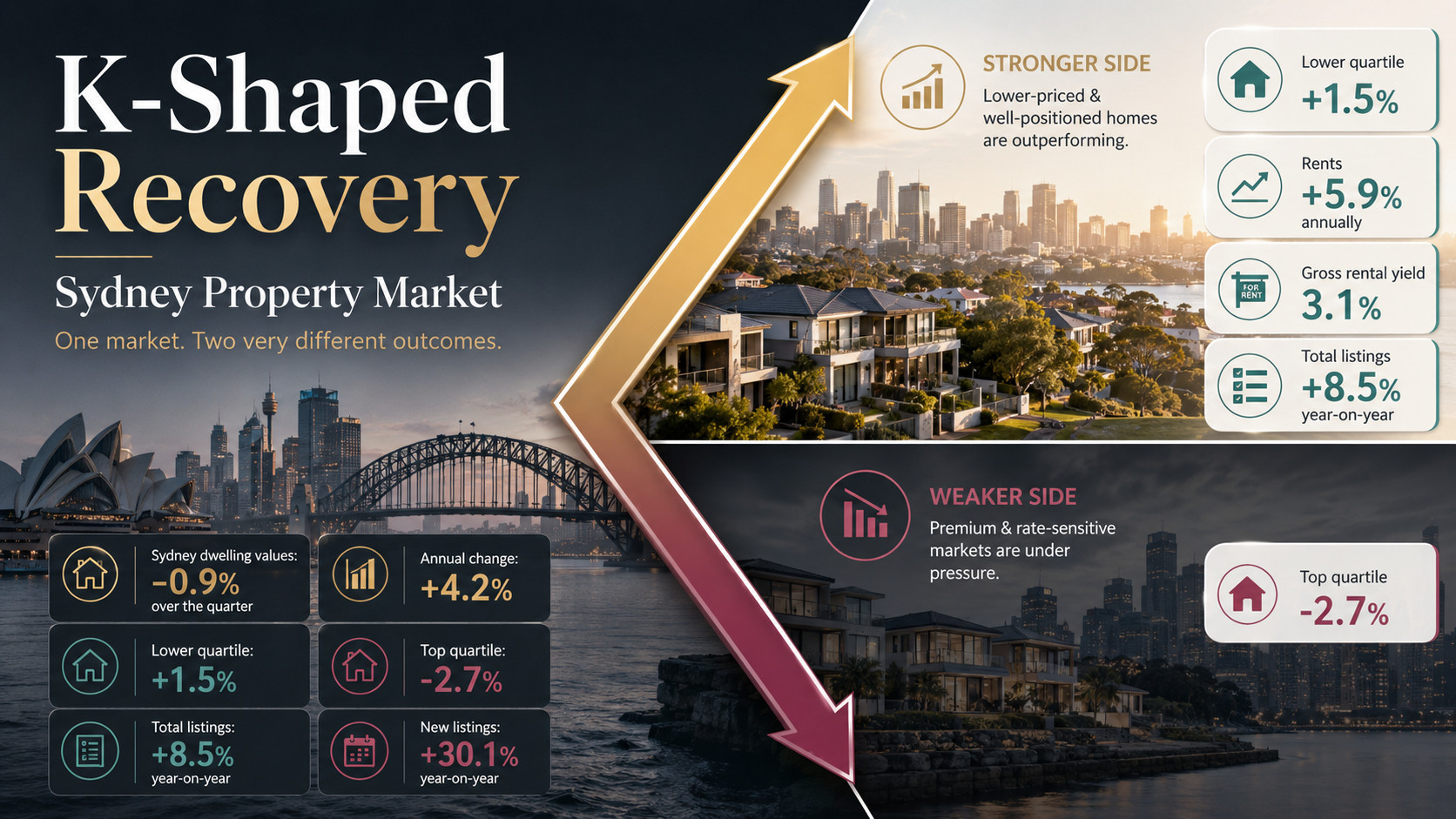
Sydney dwelling values are not collapsing, but the momentum has clearly turned. Cotality shows Sydney dwelling values were:
- down 0.6% in April
- down 0.9% over the quarter
- still up 4.2% over the year
- 1.0% below the November 2025 record high
That is the first sign of the “K”. The annual number still looks positive, but the current quarter and monthly movement show the market has already softened.
The real K-shape is inside Sydney itself
The strongest evidence is on the value-segment chart. Sydney’s lower quartile rose 1.5% over the quarter, the middle market rose only 0.4%, while the highest-value quartile fell 2.7%.
That tells us Sydney is not one market.
The affordable end is still being supported by first-home buyers, investors, rental pressure and scarcity. The prestige and upper end are more exposed to interest rates, borrowing capacity, weaker sentiment and discretionary buyer behaviour.
In plain English: the bottom arm of the K is not “cheap property” — it is over-stretched, rate-sensitive, premium property where buyers have more choices and more bargaining power.
Listings are giving buyers more power
Sydney’s total advertised stock is now 8.5% higher than the same period last year, while new listings are 30.1% higher. That matters because a K-shaped market is not only about price movement. It is also about who has leverage.
More stock does not automatically mean prices fall everywhere. But it does mean weaker properties, overpriced listings and homes with poor presentation will sit longer and be forced to discount.
Cotality also notes that discounting is building, with Sydney’s median vendor discount around -3.3%, compared with -3.2% a year earlier. Median days on market in Sydney were 31 days, slightly higher than 30 days a year earlier.
Rates are separating buyers
The RBA cash rate has returned to 4.35%, reversing the 2025 cuts, and Cotality warns that higher interest rates are a key downside risk because they stretch serviceability and household balance sheets.
This is where Sydney becomes very K-shaped.
Cash buyers, downsizers with equity, established homeowners and high-income buyers with low debt are still active. But leveraged buyers, first-home buyers and investors relying heavily on finance are more constrained.
NSW also has the highest investor share of lending demand in the country at 45.0%, while first-home buyers represent only 27.0% of owner-occupier lending in NSW, one of the lowest shares nationally.
That creates a two-speed buyer pool: equity-backed buyers can still move, while debt-backed buyers are being squeezed.
Rental pressure is supporting the lower and investor market
Sydney’s rental market is still tight. Cotality shows Sydney rents rose 5.9% over the year, while Sydney’s gross rental yield remains the lowest of any capital city at 3.1%.
This is another K-shaped signal. Rents are rising, but yields remain low because Sydney prices are still expensive. For investors, the rent story is strong, but the cash-flow story is still difficult once higher interest, strata, land tax and holding costs are included.
Alan Weiss view
Sydney is not in a normal rising market or a normal falling market. It is becoming a selection market.
The stronger arm of the K is made up of properties with scarcity, location, lifestyle, quality, light, parking, views, strong building reputation and realistic pricing.
The weaker arm is made up of compromised stock, over-priced campaigns, high-strata apartments, properties needing work, secondary locations and premium homes where vendors are still pricing off 2025 confidence.
For sellers, the lesson is simple: do not rely on last year’s market. Pricing, presentation and negotiation now matter more.
For buyers, the opportunity is also clear: the headline market may look steady, but underneath it, the gap between strong property and weak property is widening.