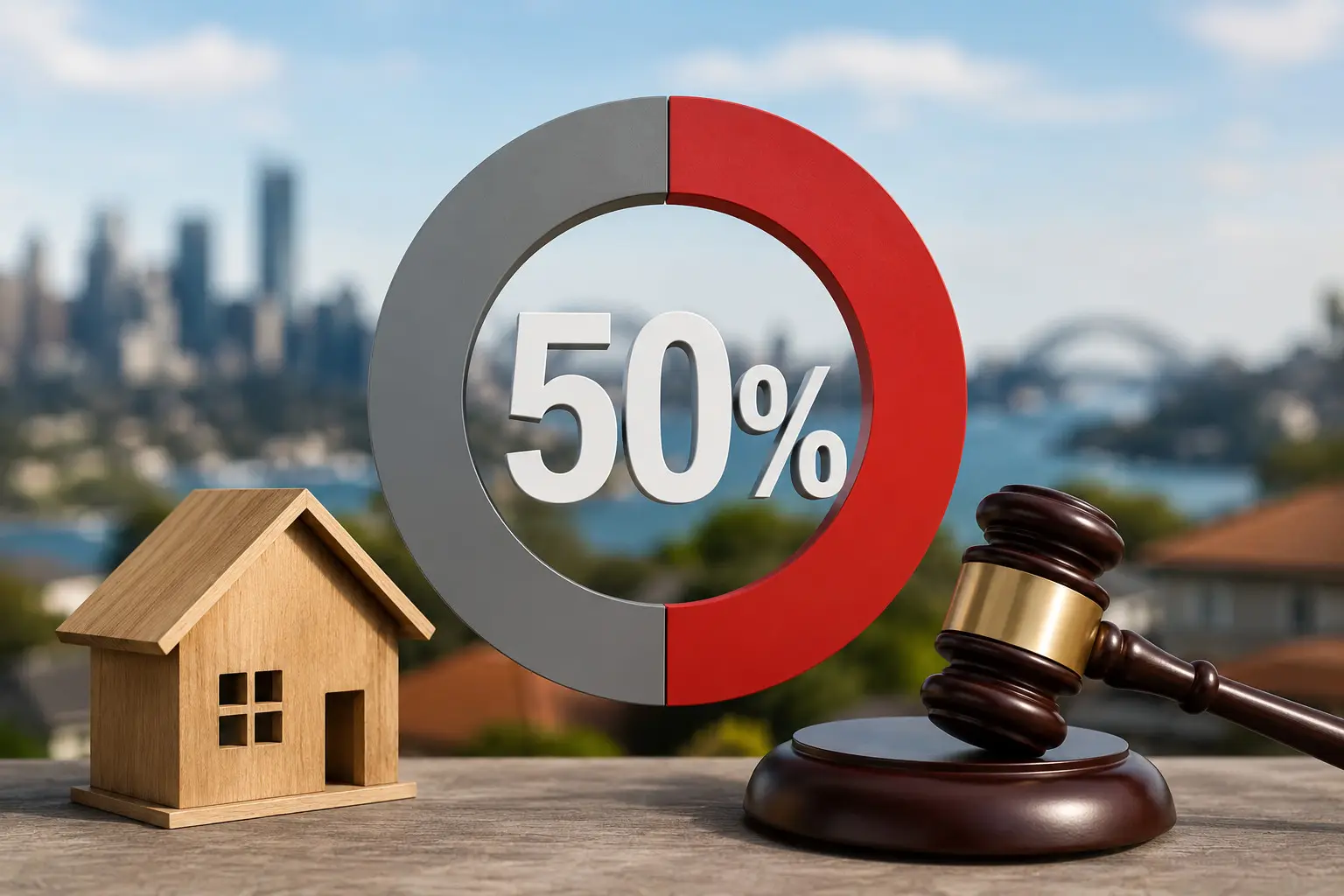
For the first time since the pandemic, Sydney’s auction clearance rate has fallen below fifty per cent. The number itself matters less than what a softer market exposes — about how property is really bought and sold, and about the kind of agent the moment now calls for.
n the first weekend of 2026, close to four in five Sydney properties taken to auction sold under the hammer. By the end of May, it was barely one in two. The city’s clearance rate had slipped beneath fifty per cent — the first time those numbers have been seen since April 2020, when the country had just shut its doors and no one knew what came next.
That comparison is worth sitting with for a moment. The last time auctions cleared this thinly, we were in the opening weeks of a pandemic — a genuine shock, sudden and total. Today there is no such event. Only interest rates that have stayed higher for longer than most expected, a steady wave of new listings through autumn, and buyers who have quietly decided they are no longer in any hurry.
Click to view
78% Clearance rate, early 2026
51% Clearance rate, late May 2026
2020 Last time below fifty per cent
A falling clearance rate is not, in itself, a crisis. It is a change in temperature. Vendors are meeting the market more slowly; more auctions are being withdrawn or settled by negotiation rather than on the day. None of this is unusual late in a cycle. What is useful about a softer market is that it is honest. It strips away the theatrics of a boom and shows you, plainly, how the business of selling property actually works.
The fiction of the secret buyer
For most of the past four decades, the industry traded on a single, durable idea — that the agent held something the public could not reach. A database. A private list. A circle of qualified buyers known only to them, waiting in the wings for the right property to appear.
It was a powerful pitch, and for a long time it was even partly true. Before the internet, the agent was genuinely the gatekeeper. Buyers found out about properties by walking into an office, reading the Saturday paper, or being on someone’s list. Information was scarce, and whoever controlled it held the leverage.
That world is gone. Today the buyer finds your property online, often before any agent has spoken to them. Millions of Australians search the major portals every month; serious buyers in the Eastern Suburbs know what is for sale, what recently sold next door, and what the owner paid for it in 2014. The data that was once locked in a filing cabinet is now open to anyone with a phone. So when an agent tells you their value lies in exclusive access to buyers, ask yourself a simple question — exclusive to whom? The buyer is not hidden in one person’s private vault. The buyer is online, and so is everyone else’s.
If an agent’s whole case rests on a secret list of buyers, the secret is usually the price.
What “off-market” really means
This is where I will be more candid than most in my position would be. I spent much of thirty-five years inside the industry, including its larger agencies, and I can tell you how the so-called off-market sale actually functions.
When a property would not sell, we did not reach into a hidden reserve of eager buyers. We uplisted it — and quietly sent the link to the very buyers’ agents who would then present it to their own clients as a discreet, off-market opportunity. The “private buyer” you were told about was, more often than not, simply another agent working the same public listings you could see yourself. And when a buyer is convinced a property is a rare, secret, off-market chance, there is usually one feature attached to it: it is well overpriced. Scarcity, real or manufactured, is what justifies the number.
I do not say this to disparage buyers’ agents — a good one earns their fee, and there is a real place for representation on the buying side. I say it because you deserve to understand the machinery before you decide who should operate it on your behalf.
The gap no one fills
Here is what the market has never properly offered. On one side sits the selling agent, whose job is to sell the property in front of them. On the other sits the buyers’ agent, whose job is to place their client into a property. Each advocates for one side of one transaction. Yet most people who sell are also, in the same breath, buying — downsizing into something smaller, moving the family, repositioning into a development. They are standing on both sides of the line at once, and no single person is advocating for them across the whole of it.
That is the gap. Not access to listings, which everyone now has. Not data, which is shared. What is genuinely scarce is judgement — someone with the experience to sit on your side of the table through the entire process, advising on the sale and the purchase together, where the interests are connected and the timing has to be managed as one.
Why I work this way
This is the point of difference I have built my practice around, and it is why I do not believe in the volume model. An agent carrying thirty listings cannot give any one of them genuine counsel; the business depends on turnover, not on the outcome for the individual in front of them. I would rather work with a handful of clients at a time and manage the whole of their move — the preparation, the presentation, the method of sale, and where it applies, the purchase on the other side — personally, from the first conversation to settlement.
Everyone now has excellent tools. The portals, the data, the photographers, the styling — these have been levelled across the industry. What cannot be levelled is thirty-five years of watching Eastern Suburbs cycles turn, and the willingness to advocate for your interests on both sides of a transaction rather than just the half that pays a commission this month.
A market below fifty per cent is not a reason for anxiety. For a well-advised vendor, it is simply a market that rewards strategy over noise — which has always been the only kind of market I am interested in.