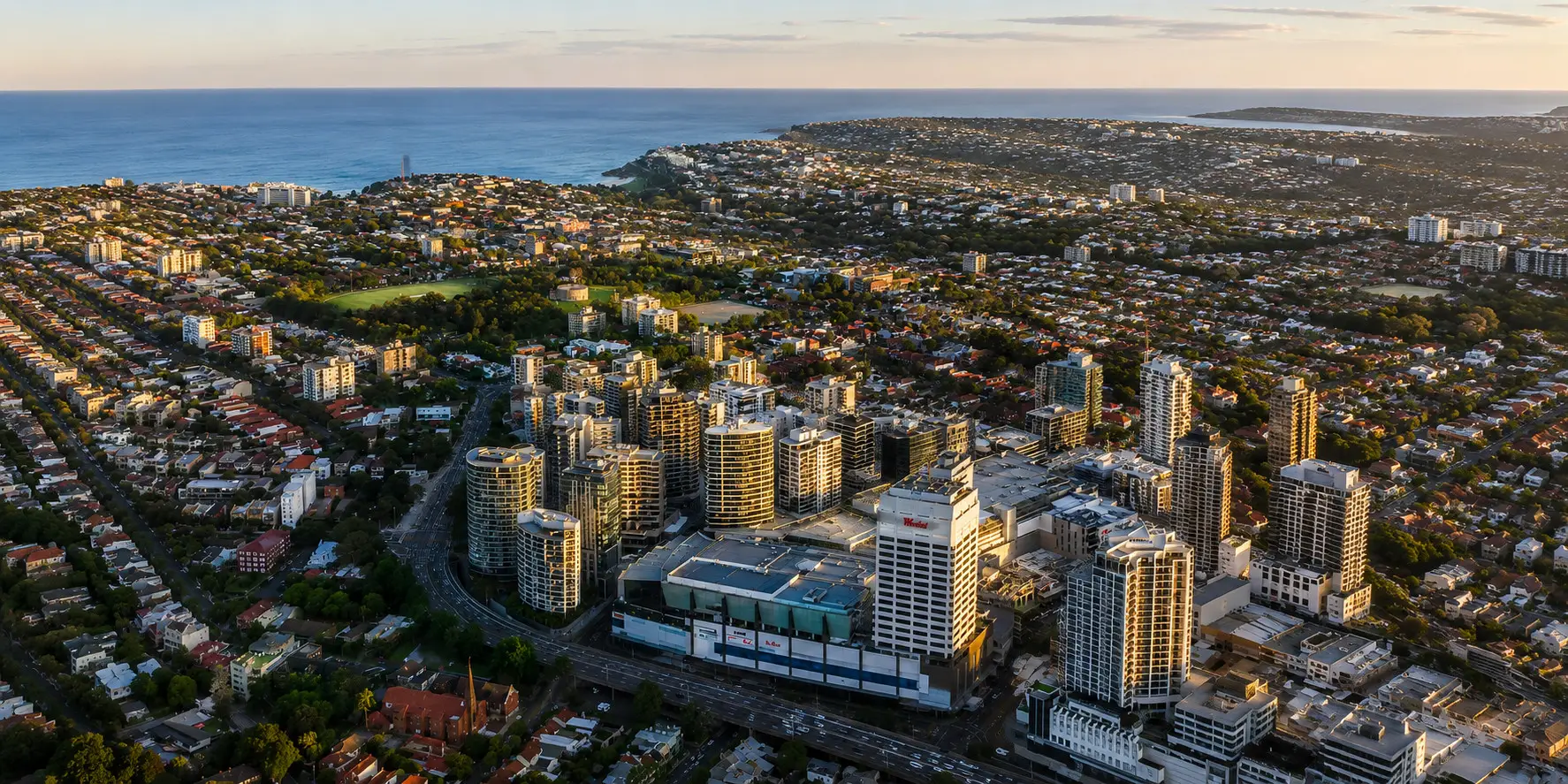
I pulled the Bondi Junction house sales recorded so far this year and laid them next to the suburbs around it. The picture is a useful one — and a little against the grain.
I find you learn more from a suburb’s actual sales than from any headline median, so I went and gathered the house sales recorded in Bondi Junction between early January and the start of June this year — nineteen of them. Together they turned over just under $69 million, and they tell you a fair bit about where this particular pocket of the east sits in 2026.
The middle of the market came in at $2,855,000 — which, reassuringly, lines up almost exactly with Cotality’s published Bondi Junction house median of around $2.88 million. So the data in front of me isn’t an outlier; it’s the real market. The spread ran from $1.85 million, for a three-bedder on Old South Head Road, all the way up to $10 million for a five-bedroom holding on Ruthven Street. That top sale is worth pausing on, because it sat on 431 square metres — nearly three times the median block of 150 square metres — and in a suburb of compact terraces and semis, land at that scale is the genuinely scarce thing. It’s the exception that proves the rule.
Strip the outliers away and the typical Bondi Junction house this year is easy to picture: a three-bedroom terrace or semi on a tight block, trading somewhere between $2.2 and $2.9 million. Three-bedders made up eleven of the nineteen sales, at a median of $2.71 million, and well over half the suburb’s sales — fifty-eight per cent — landed under $3 million. That’s what makes Bondi Junction what it is: by the standards of this part of Sydney, it’s the accessible address.
One small thing the data threw up that I rather liked: Ruthven Street alone accounted for five of the nineteen sales, and St James Road another three. When a single street turns over that often in half a year, it usually means a particular kind of stock — here, rows of comparable terraces — is being repriced more or less in real time. For anyone buying or selling on those streets, the comparables are unusually fresh.
Where Bondi Junction sits against its neighbours
Here’s where it gets interesting. Set Bondi Junction beside the suburbs that surround it and a clear pattern shows up.
| Suburb | House median (12 mths) | Annual change |
|---|---|---|
| Bondi Junction | ~$2.88m | −2.9% |
| Queens Park | ~$4.08m | — |
| Woollahra | ~$4.95m | +12.8% |
| Bondi | ~$5.40m | +24.4% |
| Rose Bay | ~$5.10m | −6.0% |
| Bellevue Hill | ~$9.45m | −5.5% |
House medians, rolling twelve months, Cotality and Domain, to mid-2026. Small-sample suburbs swing hard year to year — read the direction, not the decimal.
Two things stand out. The first is just how much more affordable a Bondi Junction house is than almost anything around it. You’re buying in at a median roughly $2 million below Bondi or Woollahra, and a third of the price of a Bellevue Hill house. Cross Old South Head Road or Oxford Street and the entry price changes completely. For a buyer who wants a freestanding house in this part of the east without a harbourside budget, Bondi Junction is very often the only door still open.
The second is the direction of travel — and this is the part that runs against the grain. Bondi Junction’s median has eased about three per cent over the year, while its immediate neighbours have done the opposite: Woollahra up nearly thirteen per cent, Bondi up a remarkable twenty-four. On the face of it, that looks odd. The cheaper suburb falling while the dearer ones climb is the reverse of the broad citywide story, where it’s the very top end feeling the most pressure.
I’d be honest about what’s behind it, because the explanation matters more than the number. Part of it is real: Bondi Junction is a busier, more transactional suburb than its neighbours — a transport and retail hub with through-traffic, smaller blocks, and a steady supply of apartments competing for the same buyer. It doesn’t carry the lifestyle premium of the beach or the character premium of Woollahra’s terraces, so when buyers turn cautious, it’s the first to feel it. But part of it is also the small-sample effect I keep banging on about. Bondi’s twenty-four per cent and Woollahra’s thirteen are built on a few dozen sales each, and a handful of big renovated or trophy results can lift a median like that without the house next door being worth a cent more. In suburbs this thinly traded, the median is a headline, not a valuation — and that cuts both ways.
What I’d take from it
If you’re buying, Bondi Junction remains the most sensible way into a freestanding house in the eastern beaches without stretching to harbourside money — but the value is in the block and the position, not the postcode. The $10 million Ruthven Street result and the $1.85 million Old South Head Road one are barely a kilometre apart; land size, aspect and which side of the busy roads you sit on are doing most of the work. Buy the right block and you’re buying the scarce asset. Buy the wrong one and you’re paying eastern-suburbs money for compromises you’ll feel every day.
If you’re selling, read the softness honestly. The suburb’s twelve-month figures show prices easing, time on market sitting around seven to eight weeks, and vendors discounting by roughly ten per cent off their first asking price — which tells you the buyer has room to be choosy and is using it. That’s not a market that rewards an ambitious quote and a wait-and-see campaign. It rewards a price set on this year’s evidence — and in Bondi Junction, with streets like Ruthven turning over so often, that evidence is sitting right there to be used. The homes that are selling well are the ones priced to the sales around them, not to last year’s hopes.
None of this makes Bondi Junction a lesser suburb. It makes it a clearer one — a place where the numbers are visible, the comparables are fresh, and a buyer or seller who reads them properly can act with more confidence than almost anywhere else in the east. That’s worth more than a flattering median.
Alan Weiss is the principal of Weiss Real Estate, a strategy-led practice serving Sydney’s Eastern Suburbs since 1990. 0412 176 074 · alan@weissrealestate.com.au
This article is general commentary, not financial advice. Sale figures drawn from recorded Bondi Junction house transactions, January to June 2026. Comparative suburb medians: Cotality (formerly CoreLogic) and Domain, rolling twelve months to mid-2026.