Market letter · Foreign investment
When the buyers changed
The headlines say Chinese investors are dumping Australian homes. The register says something quieter, and more useful — about where offshore money is going, and why some of it is now staying home.
There is a version of this story built for alarm, and a version built for understanding. I prefer the second.
The Australian Taxation Office’s Register of Foreign Ownership of Australian Assets, released in its 2024–25 report, shows that investors based in mainland China held 22,272 Australian residential properties in the 2025 financial year, down from 23,550 the year before — a fall of 5.4 per cent. Hong Kong-based ownership also eased, from 3,486 to 3,396. Set the register alongside Foreign Investment Review Board approvals for the same period, and the combined net reduction implies roughly 2,800 properties were sold down by that group. It is an estimate, not a settlement count — an approval is not a purchase, and a disposal takes its own time — but the direction is not in doubt. Chinese investors have become net sellers, and the gross figure runs into the thousands.
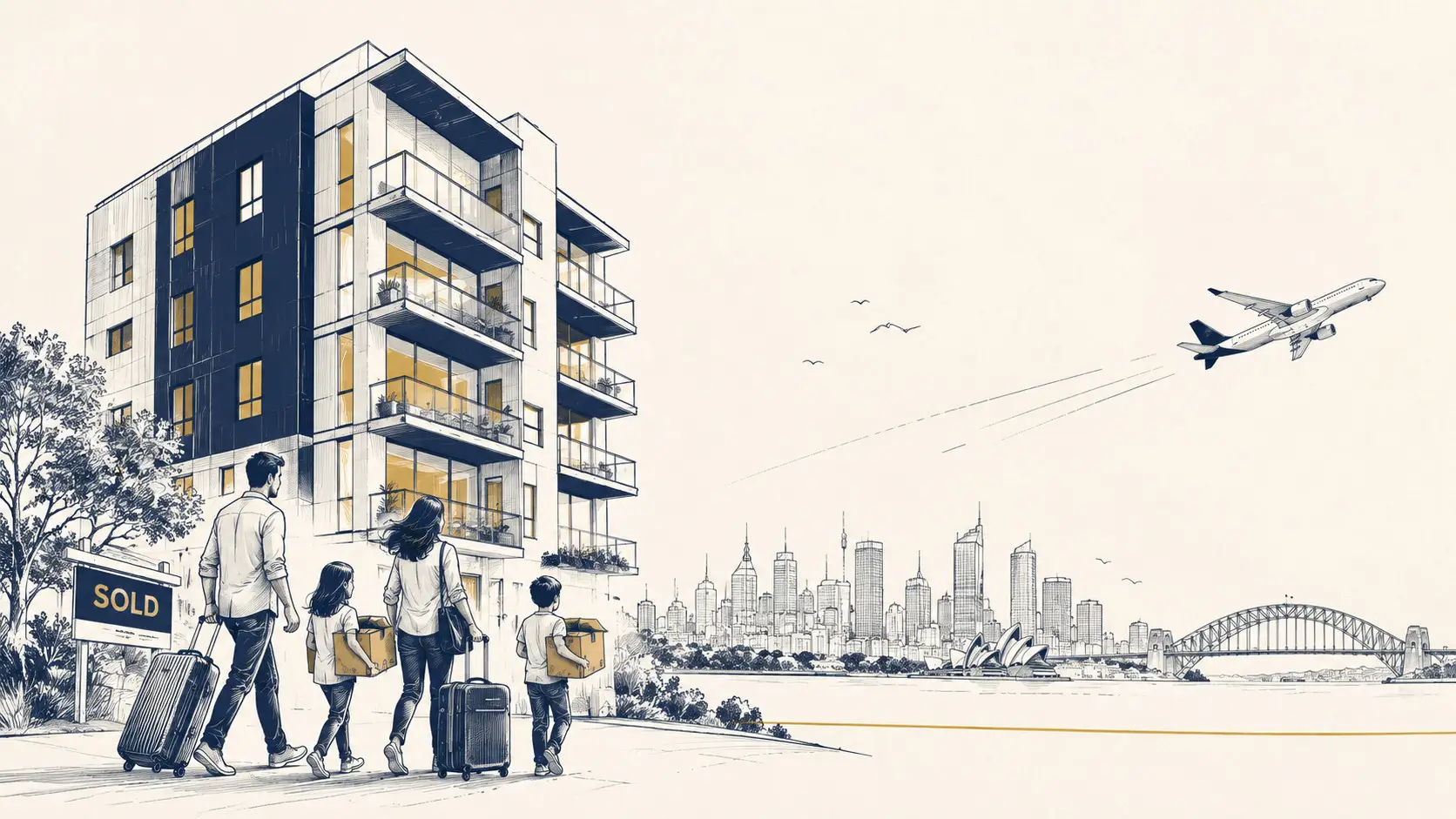
That is the number the headlines want. Here is the number they leave out: total foreign-held residential interests in Australia did not fall. They rose slightly, from 40,177 to 40,460. The Chinese retreat was met, almost dollar for dollar, by capital from elsewhere — most strikingly Japan, where ownership climbed 46 per cent, from 1,168 to 1,711, overtaking both the United Kingdom and the United States. Foreign demand did not leave. It changed passport.
To understand why it is leaving China’s name behind, it helps to remember why it arrived under that name in the first place.
Why they came
Between roughly 2013 and 2017, mainland Chinese buyers were the defining offshore force in the Sydney apartment market. The reasons were rarely about the apartment. Australia offered what China, at that moment, could not reliably promise a wealthy family: a stable currency, secure title, the rule of law, clean air, and a university place for a child who might later become a migration pathway for the parents. The Significant Investor Visa made property a side-door to residency for those investing at scale. And our prices — improbable as it sounds now — looked reasonable against Beijing, Shenzhen or Guangzhou, with far more space for the money.
It mattered where that money landed. Because foreign buyers who are not temporary residents have long been confined to new dwellings, the demand concentrated almost entirely in off-the-plan apartments in Sydney and Melbourne. The Reserve Bank, reviewing the period, noted that a sharp withdrawal of Chinese demand would weigh most heavily on the apartment markets of inner Melbourne and parts of Sydney — not only because Chinese buyers were prevalent there, but because the practice of buying off-the-plan raises the risk of price declines if a large volume of apartments returns to the market when original purchases fail to settle.
Foreign demand did not leave. It changed passport.
The tide went out for a specific reason. On the last day of 2016, the People’s Bank of China tightened capital controls, capping foreign-currency conversions at US$50,000 per person and explicitly restricting the purchase of foreign property from 1 July 2017. The effect was immediate: Chinese overseas direct investment in Australia fell from US$11.5 billion in 2016 to US$2.4 billion by 2019. The buyers who had defined a market bought one or two properties a year, where they had once dominated.
Why the pull has reversed
Two forces are now working against the old flow — one at home in China, one here.
At home, the arithmetic has changed. After a property downturn now in its sixth year, prices in China’s own first-tier cities have fallen so far that domestic property has become the bargain. In Shanghai, some lived-in flats have almost halved from their peak, and buyers are actively hunting those discounts as prices show signs of bottoming. Across many cities, values have fallen more than 40 per cent from the top, and some more than 50. I would put the point plainly, as my own reading rather than anyone’s forecast: a wealthy Shanghainese family weighing a discounted flat at home against a heavily taxed apartment in Sydney is not making the same decision they made in 2015. For the first time in a decade, the opportunity may be in the home market — though I would stress the Chinese recovery is uneven and contested, strongest in the top-tier cities and still absent in the rest.
Here, we have made ourselves expensive on purpose. That is the part worth spelling out, because owners rarely see the full stack.
What it now costs a foreign buyer
Take a $2 million new apartment — the kind of stock a foreign buyer is actually permitted to purchase. The impost of being foreign, over and above what any local pays, looks roughly like this.
The foreign-buyer stack · NSW
A $2 million new apartment
Costs a foreign buyer carries that a local does not.
There is one more thing that stack does not price: choice. From 1 April 2025 to 30 June 2029, foreign persons are banned from purchasing established dwellings altogether — a ban the government has now extended from its original 2027 end date. New or off-the-plan is effectively the only door left open. Australia has not banned foreign capital. It has priced it, deliberately, to send it towards new supply and away from established homes. The register simply shows the policy working.
Australia has not banned foreign capital. It has priced it.
What it means for off-the-plan
This is where the two stories meet, and where Eastern Suburbs owners should pay attention. Off-the-plan is the one channel still open to foreign buyers — which cuts both ways.
On one hand, the established-dwelling ban funnels whatever offshore demand remains straight into new apartments; a foreign buyer who wants Australian property has nowhere else to put it. On the other, if the largest historical source of that demand is selling down and looking home instead, the pre-sales that make new towers financeable become harder to assemble. Developers rely on those pre-sales — often a meaningful share of them offshore — to clear the thresholds their lenders require before a crane ever moves. Thin foreign pre-sales mean projects that stall, launch late, or don’t launch at all. And where apartments were bought years ahead by buyers who then can’t settle — through currency controls, tighter finance, or changed circumstances — stock returns to the market at precisely the wrong moment. It is the settlement-risk problem I’ve written about before, now with a shifting buyer base underneath it.
A change of composition, not the end of foreign investment
The register’s real message is not that foreign buyers have gone. It is that nationality has stopped being a reliable proxy for offshore demand. The mainland Chinese wave that shaped a decade of Sydney apartment sales is receding; Japanese, Singaporean and other Asian capital is rising to meet the gap. For anyone selling in this market, the lesson is to stop marketing to a stereotype and start marketing to a broader, quieter, more diverse international buyer — one who is harder to see and no less serious.
For our part of Sydney, the direct exposure is modest — the Eastern Suburbs was never an off-the-plan investor market in the way the inner west or the apartment corridors were. But the second-order effects are worth watching: a thinner development pipeline, a more selective new-apartment market, and a class of overseas buyer who, faced with the cost of entry here and the discount available at home, may simply decide this is the year to buy in Shanghai instead.
That is not a crisis. It is a market doing what markets do — reallocating. The work, as ever, is to read it accurately before everyone else calls it a headline.
Sources
Australian Taxation Office, Register of Foreign Ownership of Australian Assets 2024–25 Report · Foreign Investment Review Board / Treasury residential guidance · Reserve Bank of Australia, Financial Stability Review · Revenue NSW and NSW Government (surcharge purchaser duty and surcharge land tax) · People’s Bank of China capital-control measures (2016–17). Forward-looking observations on the Chinese domestic market are my own assessment, drawn from NBS and market reporting current to mid-2026.