The unit market here is ticking over, and a landmark penthouse just changed hands for $6.6 million. But with hundreds of brand-new apartments in the pipeline, the more important question for buyers isn’t what’s selling — it’s what all this new stock will be worth a few years from now.
Bondi Junction has quietly become one of the busiest apartment markets in the eastern suburbs, and this year’s sales show why. I gathered the unit sales recorded across the suburb so far in 2026 — twenty of them — and they paint a picture of a market that’s active, broad, and, at the top end, capable of some serious numbers. They also raise a question I think every apartment buyer here should be asking, and I’ll come to it.
What’s selling, and for how much
The middle of the unit market sat just above $2 million — a median of $2,047,500 across the twenty sales, with about $50.5 million in total turnover. The spread tells the real story. Two-bedders came in around a median of $1.77 million, three-bedders closer to $2.75 million, and prices ranged from $1.61 million for a three-bed unit on Botany Street all the way to $6.625 million for the penthouse at 568 Oxford Street.
A few buildings did much of the heavy lifting. The Spring Street tower at number 71–85 alone accounted for four of the twenty sales, all on high floors, trading between $2.74 and $3.5 million — the kind of repeat turnover that tells you a building is liquid and its pricing is being tested in real time. That’s useful for buyers and sellers alike: in a building that trades often, the comparables are fresh and the guesswork is smaller.
So the surface read is healthy. But the sale that’s worth dwelling on is the big one — because of what it says about value, not just price.
The penthouse at the Archibald — a cautionary number
The top sale of the year so far was apartment 1701 at 568 Oxford Street — the penthouse in the Archibald Residences, one of Bondi Junction’s newest landmark towers, designed by Urban Possible and KANNFINCH, with concierge, a terrace garden, and 180-degree views from Botany Bay to the Harbour Bridge. A genuinely beautiful apartment. It sold in April for $6,625,000.
Here’s the part that matters. As I understand it, that apartment first sold off the plan only a few years ago for around $5.7 million. On paper, then, the owner is up roughly $925,000 — a tidy headline. But headlines aren’t returns. The stamp duty alone on a $5.7 million purchase in New South Wales would have been well over $300,000. Add the selling costs on the way out, plus several years of strata levies on a full-service, concierge-staffed building — which are not small — and that $925,000 starts shrinking quickly. By the time it’s all counted, the real gain over those years is modest, and in inflation-adjusted terms it may be barely positive at all.
That’s not a knock on the apartment, or the building. It’s a knock on an assumption — the assumption that brand new and prestige automatically means strong capital growth. The data from this very building says otherwise. Public records for another Archibald apartment show it bought for $2 million in 2017 and resold for $2.1 million in 2024 — growth of well under one per cent a year over six years. A near-new flat in one of the suburb’s best towers, and it barely moved.
I raise it because of what’s coming next.
The wall of supply
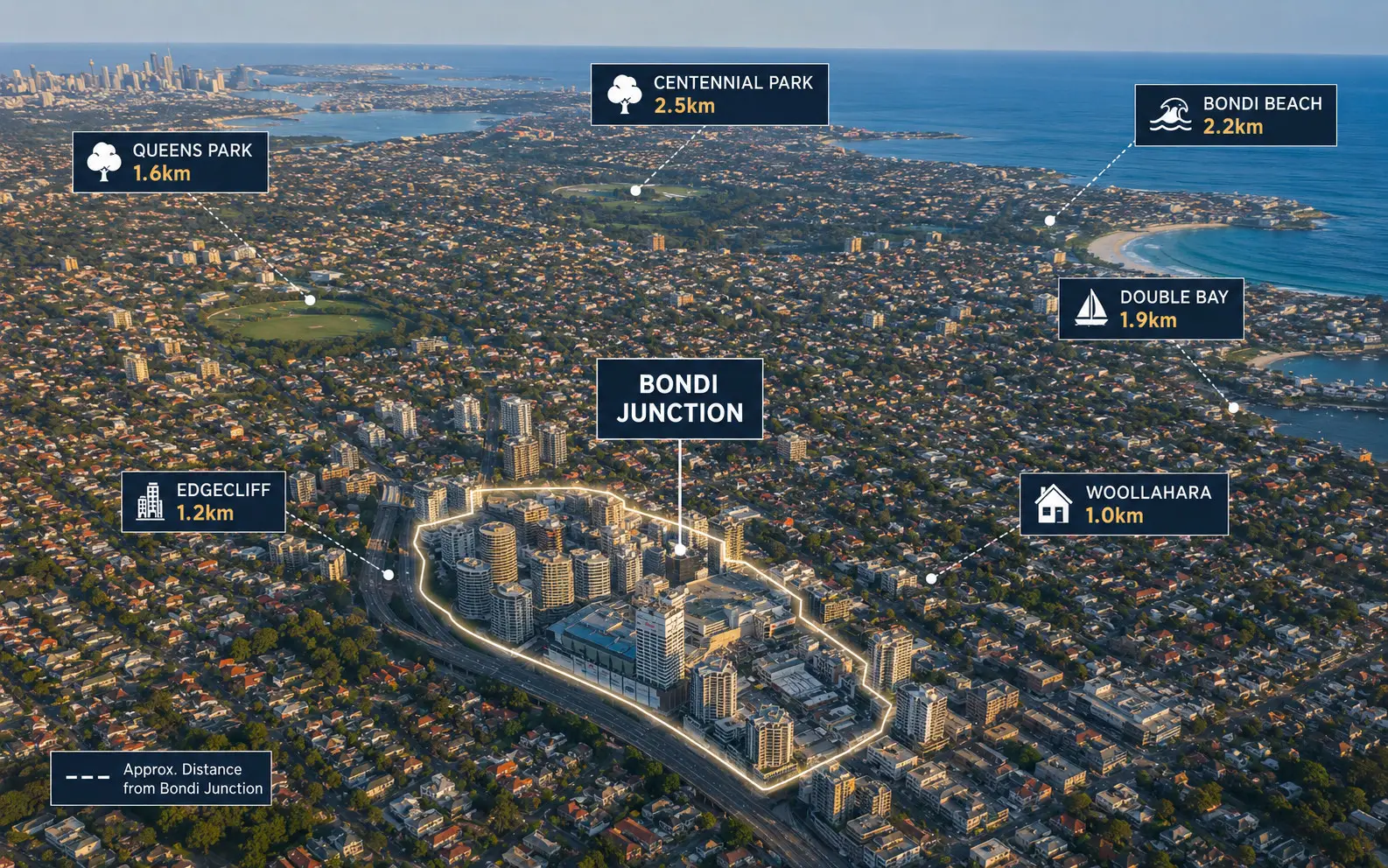
Bondi Junction is in the middle of a building boom, concentrated on two streets — Oxford and Grafton — and it’s worth seeing it laid out in one place.
Click to view table
| Project | Location | Apartments | Status |
|---|---|---|---|
| Signature (Stargate) | 362–384 Oxford Street | 111 | DA submitted, $80m |
| Westgate / Stargate | 194–214 Oxford St & 2 Nelson St | 85 | Approved via SSD, Nov 2025 |
| Grafton 59 (Clygen) | 59–75 Grafton Street | 63 | Approved (modified) |
| 55 Grafton Street | 55 Grafton Street | — | Off the plan |
| Bondi Central | Oxford Street | 86 | Recently completed |
Pipeline and approvals from NSW Planning Portal, The Urban Developer and developer filings, 2024–2026. Figures are as documented at the application or approval stage and may change.
That’s before counting Stargate’s Centennial Collection, already under construction, and the smaller infill sites dotted through the precinct. Local developer Stargate alone has completed five towers here, is building its sixth, and has now filed for a seventh. On my own reading of the precinct, there are two major buildings — one on Oxford Street, one on Grafton Street — due to complete within roughly the next six months, with several hundred more apartments behind them still working through planning. Whichever way you count it, this is a lot of near-identical new stock — mostly one- and two-bedders — arriving in a compressed window, in one small suburb.
State versus local — who’s actually deciding
There’s a governance story running underneath all this that owners here should understand, because it explains why the supply keeps coming despite the objections.
Several of these towers have been pushed through not by Waverley Council but over it. The two-tower scheme at 194–214 Oxford Street was approved through the State Significant Development pathway — a state-level process — despite objections from the council, heritage authorities and residents over its “visual dominance.” Part of the height was unlocked using an affordable-housing bonus, and objectors argued the towers ended up more than fifty per cent taller than Waverley’s own planning rules allow, casting new shadows over Oxford, Nelson and Grafton Streets and adding traffic to roads that are already strained.
You can take a view either way on whether that’s good policy — Sydney plainly needs housing, and Bondi Junction, sitting on top of a major transport interchange, is exactly where the state government wants density to go. But the practical point for a local owner is simple: the decisions shaping your street are increasingly being made above the council, on state housing priorities, and the usual local levers don’t apply. The supply is coming whether the neighbourhood wants it or not.
Where I think the real risk sits
Put those two things together — a flood of new stock, and existing new stock that has struggled to build equity — and you get to the question I opened with. Where is the value in Bondi Junction’s apartment market actually sitting?
My honest read is that brand-new apartments here are entering a danger zone, and buyers should treat them with more caution than usual. When a suburb absorbs this many near-identical new units at once, three things tend to follow. Developer pricing on the newest releases is set by the developer, supported by incentives and a polished display suite — not by resale evidence, which is the only price that’s truly been tested. Second, when you go to sell that apartment in a few years, you’re not competing against character or scarcity; you’re competing against the next brand-new building down the road, often with its own incentives. And third, an oversupplied segment is precisely where banks get cautious at valuation time — the settlement-day shortfall I’ve written about before bites hardest exactly here.
None of that makes new apartments a bad buy. For the right person — someone who wants to live in it, values the lifestyle and the lock-up-and-leave, and isn’t banking on capital growth — a new Bondi Junction apartment can be ideal. But if you’re buying with one eye on resale, the evidence in front of us is sobering: the newest, shiniest stock in this suburb has been among the slowest to grow.
What I’d tell a buyer, and a seller
If you’re buying, test every new apartment against the resale market, not the display suite. Ask what apartments in the existing new towers — the Archibald, the Spring Street buildings, Bondi Central — have actually resold for, and how long they’ve taken. That’s your real benchmark. And give serious thought to whether an established apartment with a track record of sales is the safer place to put your money than something off a plan, in a suburb about to absorb several hundred new competitors.
If you’re selling a near-new apartment, the message is the opposite of complacency: your competition is about to increase sharply. The window to sell into relative scarcity — before the next wave of stock settles and lists — is narrower than it looks. Price to the evidence, present sharply, and don’t assume the “brand new” premium will still be there in eighteen months.
Bondi Junction’s apartment market isn’t in trouble. It’s just entering a phase where the easy assumptions stop working — where new doesn’t guarantee growth, and where the buyer who reads the supply pipeline properly will make far better decisions than the one who reads only the brochure.
Alan Weiss is the principal of Weiss Real Estate, a strategy-led practice serving Sydney’s Eastern Suburbs since 1990. 0412 176 074 · alan@weissrealestate.com.au
General commentary only, not financial advice. Unit sale figures from recorded Bondi Junction transactions, January to April 2026. Development pipeline: NSW Planning Portal, The Urban Developer, apartments.com.au and developer filings (2024–2026). Building sale histories: Domain.