No say in it
For a decade, cheap money and a fear of missing out hid the forced sale inside a rising market. Both have gone — and the numbers behind death, divorce, debt and distress are now the ones setting the price.
A market at fifty per cent
Start with the clearest signal we have. On a typical Saturday in Sydney this winter, only about half the homes taken to auction actually sell. Wind back to the frenzied months of 2021 and clearance rates routinely sat above 80% — and that figure was doing more than keeping score, it was driving the result. A high clearance rate feeds on itself: people watch homes selling, they worry they’ll miss out, they bid harder, and every strong result makes the next buyer braver. At around 50%, that loop has gone quiet.
And the headline number flatters the truth, because it only counts the homes that make it to the hammer. Plenty are being pulled before auction day, or pushed back in the hope of kinder conditions later, and none of those show up in the clearance rate. Count them, and the share of sellers really meeting the market is lower again.
What’s gone is the sentiment that did the heavy lifting. Consumer confidence in June was among the weakest in the survey’s 50-year history, and the share of people expecting prices to rise over the coming year dropped to 52%, from 66% just a month earlier. Fear of missing out has turned into fear of catching a falling knife. A buyer in that frame of mind doesn’t chase. And a seller who can choose their moment will sit tight and wait for a better one — which leaves the pricing of the whole market to the people who can’t.
Fear of missing out has turned into fear of catching a falling knife.
Cotality, Home Value Index and Sydney housing update, June 2026 (auction clearance around 50%; estimated home sales over the prior three months about 17% below a year earlier). Westpac–Melbourne Institute Consumer Sentiment, June 2026 (index 80.6, among the weakest in the survey’s 50-year history; share expecting price rises 52%, down from 66%).
Why the four Ds slept for a decade
In this trade there’s a grim shorthand for the people who have to sell whatever the market is doing: the four Ds — death, divorce, debt and distress. They’ve always been with us. What’s easy to forget is how little they touched prices across the past ten years. The reason they stayed quiet is the very thing that’s now changing.
For ten years we had cheap money, too few homes for sale, a growing economy and an affordability that, for most people, still just about worked. Put a distressed sale into a market like that and you couldn’t see the distress. The divorce, the estate, the letter from the bank — every one of them put a house up for sale, and each of those houses met a room full of confident buyers who competed the hardship straight out of the price. On paper it read like any other result.
Today the picture is reversed on every count. Rates went up hard and stayed up. Lending tightened — the serviceability tests alone now cap how much a buyer is allowed to borrow. And we are carrying more household debt than almost anyone on earth: a record $3.33 trillion in 2025, around 112% of the entire economy, second only to Switzerland, with more than four mortgages in five on variable rates and exposed to every move in the cash rate. A market that geared up to the hilt and lost its fear of missing out can no longer soak up the sales it once did. It puts them on display. Let me take the four one by one.
Australian Bureau of Statistics, household balance sheet, June 2025 (record $3.33 trillion); Reserve Bank of Australia, Financial Stability Review, April 2025; IMF Financial Soundness Indicators (around 112% of GDP).
Debt: the bill the boom deferred
Personal insolvencies have climbed three years running, to 12,257 in 2024–25. That’s still short of the ten-year average of 19,586 — so no, this isn’t a flood — but the trend only points one way, and company failures are rising faster again: more than 13,000 businesses went into external administration in the year to May 2025, a third more than the year before, with construction leading the field.
Here’s the connection almost everyone leaves out — the personal guarantee. When a director borrows for the business, the bank nearly always wants that loan guaranteed against personal assets, and the asset on the table is usually the family home. The business fails, the guarantee is called in, and a company collapse filed away in one regulator’s spreadsheet turns, quietly, into a house for sale three doors down from you. The debt was never the home’s. The home settles it all the same.
Australian Financial Security Authority, personal insolvency statistics 2024–25 (12,257 personal insolvencies; ten-year average 19,586). Australian Securities and Investments Commission, insolvency statistics to May 2025 (more than 13,000 companies entering external administration, up around a third year on year, construction leading).
Divorce: the settlement that can’t wait
Money trouble and relationship breakdown tend to arrive together. The Australian Financial Security Authority puts relationship breakdown behind 14.2% of personal insolvencies — debt and separation each making the other worse. And when a marriage or partnership ends, the home is usually the biggest thing to be split, often through a sale that neither person controls. A court order, or a trustee appointed to cash the asset out, takes no notice of the property cycle. You can’t stand in front of a judge, explain that the market’s a bit soft, and ask to come back in spring.
And the headline divorce number badly understates it. There were 47,216 divorces granted in Australia in 2024 — the lowest rate since no-fault divorce arrived 50 years ago — but that figure only counts married couples. When a de facto couple splits, or a same-sex couple who never married, the property is divided under the same law and the same pressures, yet it shows up in no divorce statistic anywhere. More than two million Australians are living in de facto relationships. Count family breakdown properly and it drives far more selling than the official line admits.
Australian Financial Security Authority, State of the Personal Insolvency System 2024–25 (relationship breakdown cited as a contributing cause in 14.2% of personal insolvencies). Australian Bureau of Statistics, Marriages and Divorces, Australia, 2024 (47,216 divorces; lowest divorce rate since 1975); 2021 Census (more than two million people in de facto relationships).
Death: 30,000 estates a year
The quietest of the four is, around here, one of the biggest. When someone dies and the estate is split between the people named in the will, the home almost always has to be sold — the beneficiaries want their share in cash, not a quarter-share of a house nobody lives in. In New South Wales the Supreme Court granted 30,801 uncontested probates and administrations in 2024, up from 26,661 in 2020. Every one of those is an estate being wound up, and a good many of them contain a property that has to be sold before anyone sees a cent. The underlying numbers are only growing as the population ages: 187,268 deaths nationally in 2024, 188,156 in 2025. In an area like the Eastern Suburbs, full of homes held for thirty and forty years, the estate sale isn’t a footnote to the market. It’s a steady and rising part of it.
New South Wales Supreme Court, uncontested probate and administration grants (30,801 in 2024, up from 26,661 in 2020). Australian Bureau of Statistics, Deaths, Australia (187,268 deaths in 2024; 188,156 in 2025). — Alan to confirm exact source titles and whether the 2025 death figure is final or provisional before publishing.
The bank that doesn’t wait
Then the bluntest forced sale of the lot. When a mortgage stops being paid, the lender can take possession and sell, and a first mortgagee — comfortably under the value of the property — has every reason to act fast and not one reason to wait for the mood to lift. In New South Wales, possession actions in the Supreme Court have gone from 616 filings in 2020 to 1,632 in 2024: up around 165% in four years, and 15% in the past year alone. Plenty are sorted out before they get that far, or the owner sells first. But the line on the graph is steep, and a mortgagee sale lands harder than most, because everyone on the street can see the seller had no say in it. The valuer can see it too.
New South Wales Supreme Court, possession list filings (616 in 2020 rising to 1,632 in 2024; up around 165% over four years and 15% year on year). — Alan to confirm exact source title before publishing.
A handful of sales, and the exception turns into the rule.
How a few sales reset a street
And this is the piece most commentary skates over. Agents and valuers work by comparison — the next contract is built on the handful that settled nearby. In a busy market one distressed sale disappears into the crowd. In a thin one — and sales are running close to 17% below a year ago — there’s almost nothing else changing hands to argue against it. So when a mortgagee sale, a trustee sale or an estate goes through below what the neighbourhood assumed it was worth, that number doesn’t stay where it landed. It becomes the benchmark. The next appraisal leans on it, then the one after, and the markdown works its way across the whole suburb — not because every owner is in trouble, but because the few who were have rewritten the evidence everyone else is judged by.
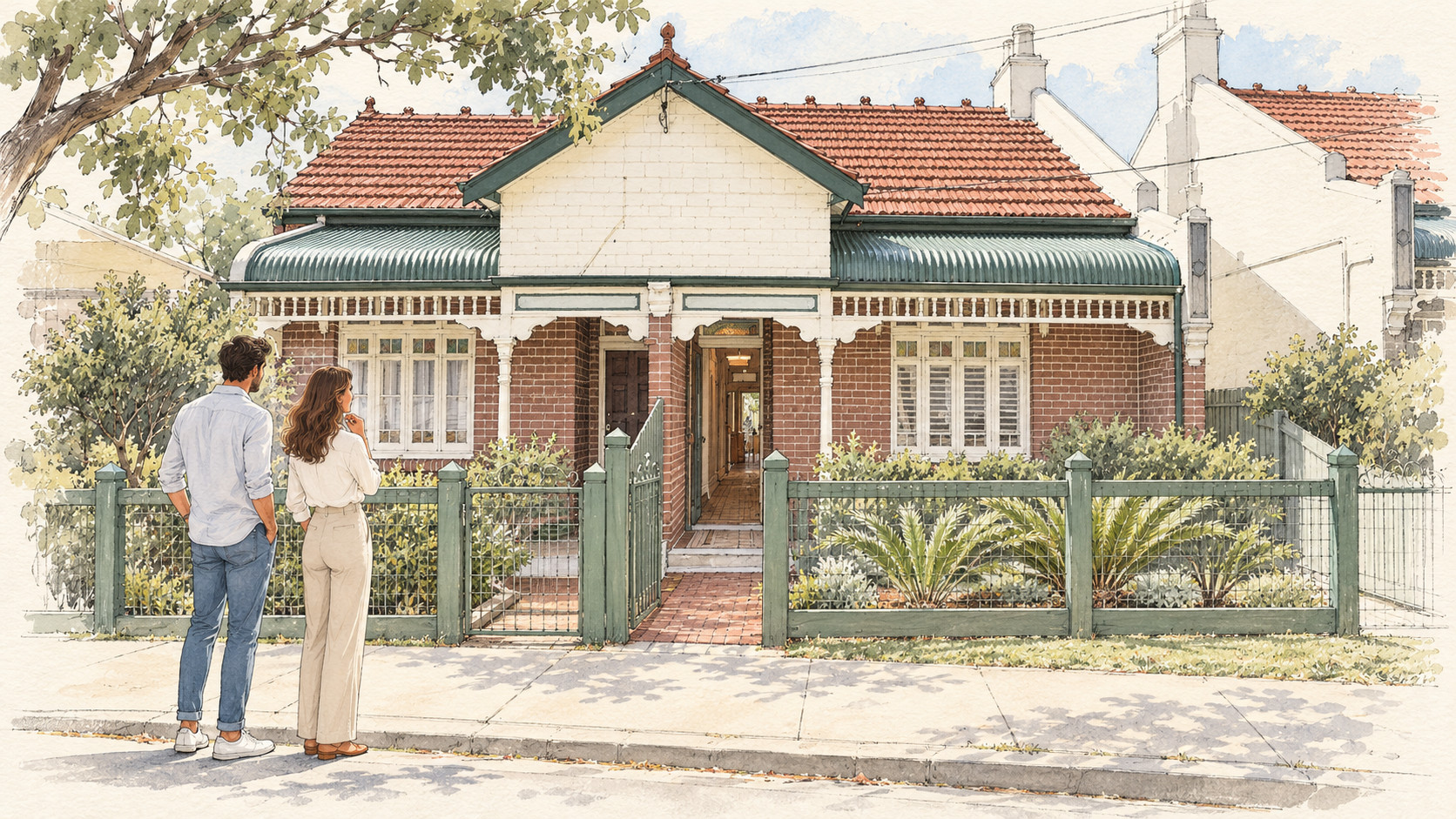
None of this is a prediction of collapse. I don’t believe in crashes, and nothing in these figures points to one. My point is smaller, and a good deal more practical for anyone with a decision to make. For ten years the market covered for the seller who had to sell. It has stopped covering. The things that used to hide death, divorce, debt and distress — cheap money, deep demand, the rush not to miss out — are gone, and the people who can’t choose their timing are the ones now drawing the line the rest of us are valued against. If your sale can wait, that patience has seldom been worth more. And if you do get to choose when you come to market, the single most useful thing I can tell you is this: look hard at who you’ll be standing next to, and ask whether any of them are there because a court, a bank or a will gave them no say in it.
That’s the lens I’d want a client of mine looking through right now. It’s a less comfortable view than the one most agents will hand you. I happen to think it’s the honest one.
— Alan Weiss
A considered appraisal from someone who has sold across the Eastern Suburbs for thirty-five years — no obligation, no pressure to list.
Request a free appraisal