New household modelling puts mortgage and rental stress at majority levels across Bellevue Hill, Bondi and Rose Bay — while the three-year price scenarios all point in the same direction: down.
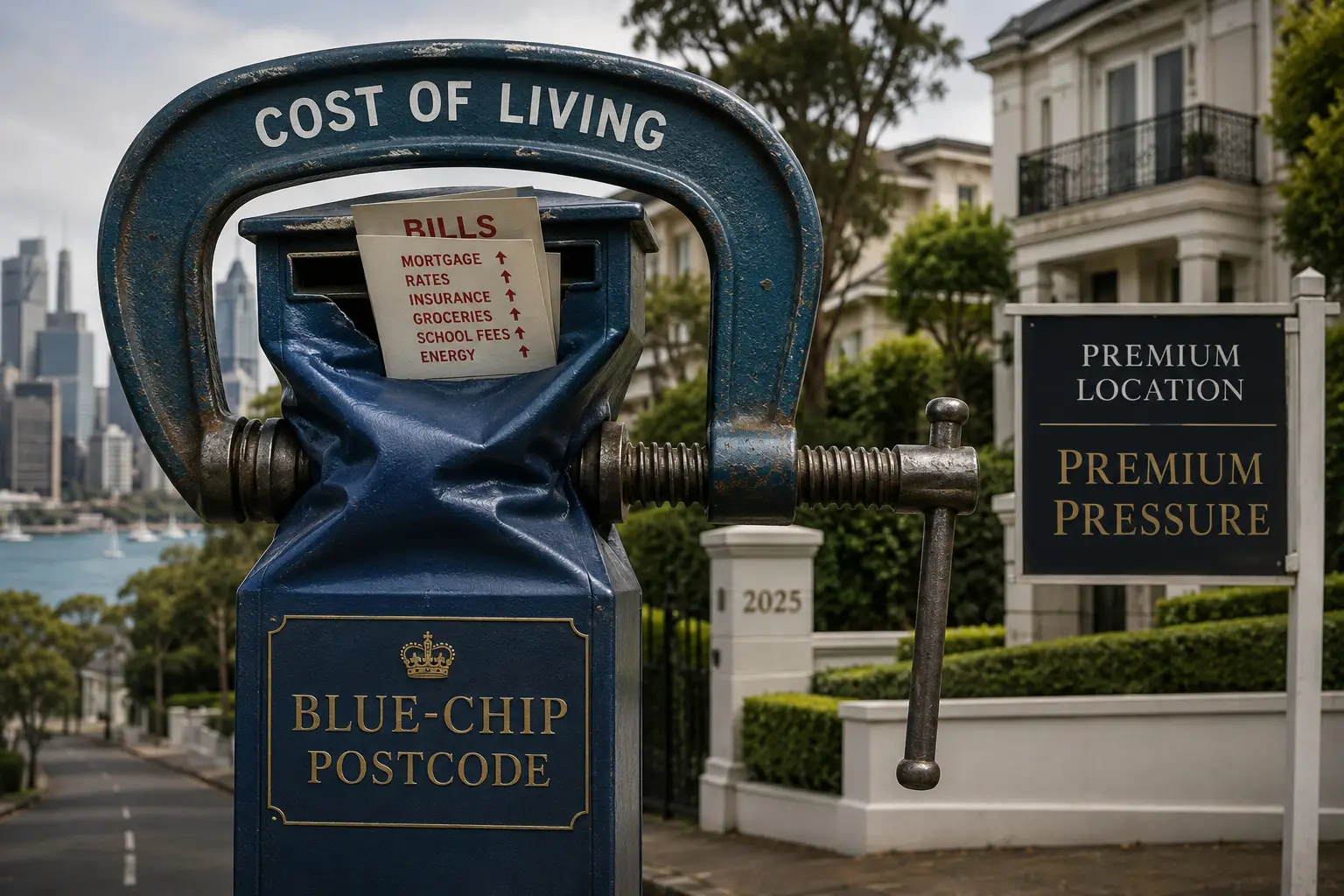
There is a comfortable assumption in this part of Sydney that the prestige postcodes sit above the fray — that harbour frontage, leafy streets and high incomes put a suburb beyond the reach of mortgage stress. After thirty-five years selling across the Eastern Suburbs, I understand why people believe it. But the latest household financial modelling from Digital Finance Analytics tells a more complicated story, and it is worth reading carefully before drawing conclusions.
I was sent the May 2026 stress data for three of our best-known postcodes — Bellevue Hill (2023), Bondi (2026) and Rose Bay (2029). The pattern across all three is consistent enough to matter: financial stress is running at majority levels, investment yields have turned negative on a cash basis, and the forward price scenarios are dipping rather than climbing. For an owner deciding whether to hold or sell, that combination is the whole conversation.
What the numbers actually say
Three figures do most of the talking. The share of households in financial stress tells you how widely the pressure is felt. The net investment yield tells you whether an investor is being paid to hold the asset, or paying for the privilege. And the price scenarios — modelled best, base and worst cases over the next three years — tell you which way values are pointed. Here is how the three suburbs compare.
| Measure | Bellevue Hill 2023 | Bondi 2026 | Rose Bay 2029 |
|---|---|---|---|
| The households | |||
| Total households | 4,385 | 14,707 | 4,331 |
| Households in financial stress | 65.5% | 80.8% | 79.7% |
| Renters in rental stress | 75.0% | 85.6% | 100% |
| Borrowers in mortgage stress | 5.5% | 16.3% | 9.1% |
| Stressed investors | 48.0% | 27.5% | 48.3% |
| The investment case | |||
| Gross investment yield | 3.5% | 3.1% | 3.5% |
| Net investment yield | −1.0% | −1.4% | −1.2% |
| Vacancy | 10.3% | 13.4% | 11.3% |
| The make-up | |||
| Units (share of dwellings) | 61.4% | 74.4% | 68.8% |
| Houses (share of dwellings) | 33.8% | 9.4% | 20.6% |
| Avg taxable income (individual, ATO) | $269,583 | $170,692 | $199,234 |
| House prices — cumulative, 36 months | |||
| Base case | −24.5% | −24.5% | −27.9% |
| Worst case | −46.3% | −46.0% | −49.6% |
| Unit prices — cumulative, 36 months | |||
| Base case | −21.7% | −21.3% | −24.2% |
| Worst case | −39.3% | −39.9% | −41.5% |
Data provided by Digital Finance Analytics (May 2026)
The first thing to notice is that there is no green in that table. Across every suburb, every price scenario — even the best case, not shown here — is negative, and the base cases cluster around a 21–28% decline over three years. That is what people mean when they say values are dipping.
Suburb by suburb
Bellevue Hill 2023
The wealthiest of the three on paper — an average individual taxable income of $269,583 — and yet the modelling still shows a net yield of −1.0% and 65.5% of households in financial stress. Nearly half its investors (48.0%) are flagged as stressed. Bellevue Hill is the most house-weighted of the group (33.8% houses), which has historically given it some insulation, but the base-case scenario still has houses down 24.5% and units down 21.7% over three years. High income, it turns out, is not the same thing as high cash flow.
Bondi 2026
By far the largest market here — 14,707 households — and the most stretched. 80.8% of households are in financial stress, mortgage stress among borrowers runs at 16.3% (the highest of the three), and vacancy sits at 13.4%. Bondi is overwhelmingly a unit market (74.4%), with the lowest average income of the group, so it carries the least buffer when rates and costs bite. The net yield of −1.4% is the weakest of the three. This is the postcode where the gap between the brand and the balance sheet is widest.
Rose Bay 2029
The figure that stops you is 100% of renters in rental stress — every one of the 1,873 renting households. Overall, 79.7% of households are in financial stress, 48.3% of investors are flagged, and the net yield is −1.2%. Rose Bay also carries the steepest forward declines in the set: a base case of −27.9% for houses and −24.2% for units over three years, and a worst case approaching −50% for houses. For a harbourside postcode, that is a sobering forecast.
How to read these scenarios. The price figures are Digital Finance Analytics’ modelled projections, not settled fact — a best, base and worst case for the three years ahead. They describe direction and magnitude of risk, not a guaranteed outcome. Markets surprise on both sides, and a well-presented home in the right pocket of any of these suburbs can still outperform the average comfortably.
What this means if you own here
Stress data and price scenarios are not a reason to panic, and they are certainly not a reason to dump a quality asset into a soft market. But they are a reason to make decisions deliberately rather than by default. A few honest questions are worth sitting with.
If you are an investor holding on a negative net yield, you are funding the shortfall out of pocket every month in the hope of capital growth — and the modelling currently has capital values falling, not rising. That is a legitimate strategy if your timeframe is long and your cash flow is comfortable. It is a far harder one if it is not.
If you are an owner-occupier thinking about your next move — upsizing, downsizing, or simply timing a sale — the key insight is that these conditions apply across the whole region at once. You are likely selling and buying in the same market, which softens the impact of any single number. What matters far more than the headline percentage is presentation, pricing and negotiation on the specific property in front of you.
And if you are weighing whether to act now or wait, the answer genuinely depends on your circumstances, not on a regional average. That is exactly the kind of decision worth talking through with someone who has watched this market through several cycles — and who has no incentive to rush you.
Important — please read. This article is general market commentary only and does not constitute financial, investment, taxation or legal advice. The stress measures and price projections referenced are modelled estimates produced by Digital Finance Analytics and are based on 2021 Census data and the provider’s own assumptions; they describe possible scenarios, not guaranteed outcomes, and may change. Property values, rents and individual circumstances vary widely. You should not make any buying, selling or investment decision in reliance on this article alone. Before acting, seek advice from a licensed financial adviser, accountant and/or qualified property professional regarding your specific situation.
Source data: Digital Finance Analytics, “Household Financial Stress” modelling, May 2026. Base census 2021. Reproduced with attribution. Analysis and commentary © Weiss Real Estate.