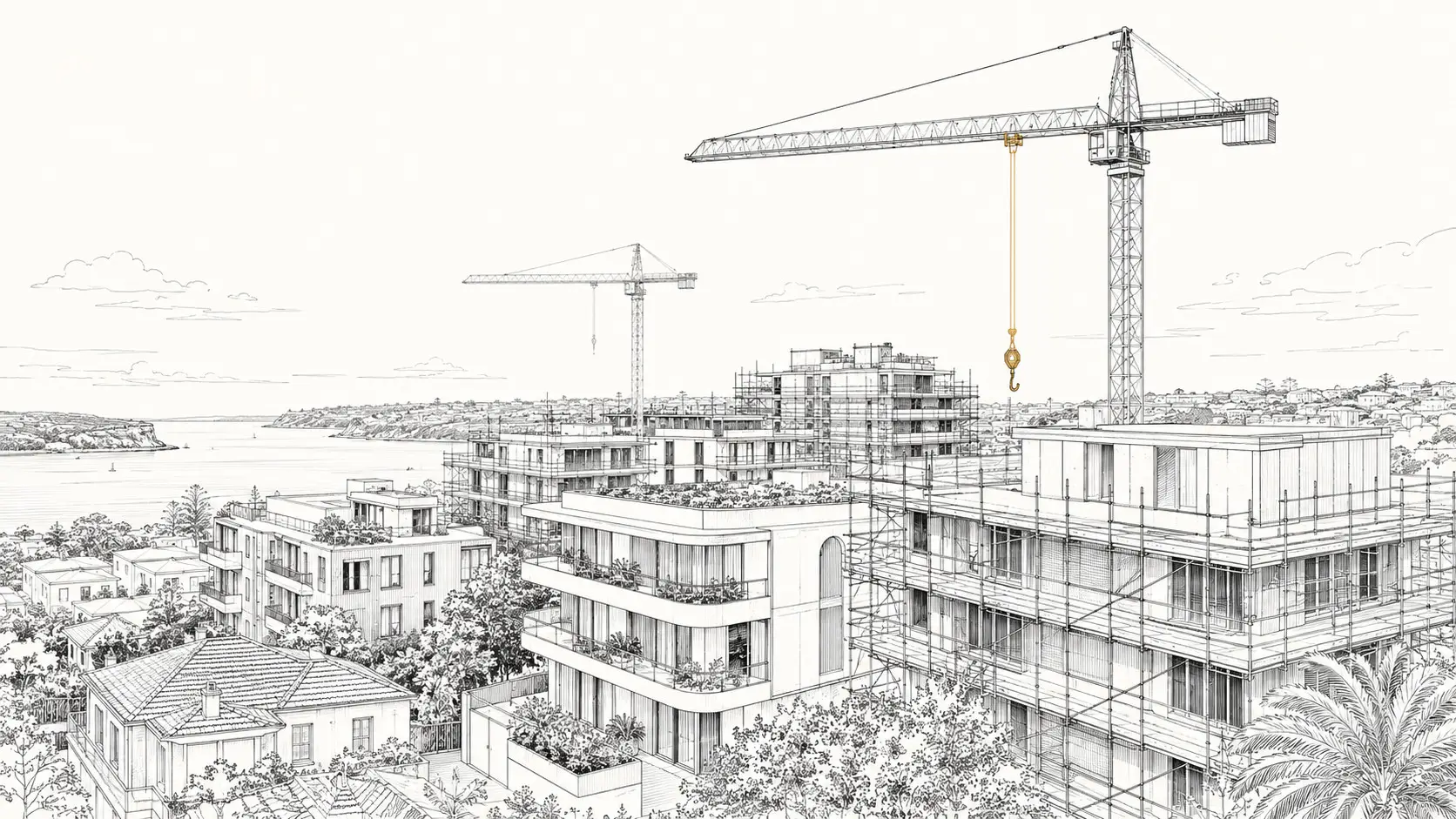
The cranes are still turning. The buyers have gone still.
A wave of new apartments is completing across Sydney — and across the Eastern Suburbs in particular — at exactly the wrong moment, as prices soften and buyers thin out. For anyone holding an off-the-plan contract, the distance between those two facts is where the risk lives.
There is a particular quiet that settles over a market when the cranes are still turning but the buyers have gone still. I have watched it happen more than once in 35 years, and I think we are in it again.
Consider the volume first, because it is real and it is concentrated. At Bondi Beach, Clutch is building AVRA, eighteen residences on Curlewis Street; Fenbury has Mayfair on Campbell Parade; Central Element is bringing Pearl to Sandridge Street. Above the junction, Stargate Property’s Centennial Collection puts 79 apartments across two towers on the Centennial Park ridgeline, with Origami rising on Grafton Street and a mixed-use tower approved on Oxford Street — before you even reach Waverley Council’s draft master plan, which proposes another 3,000 homes and a rebuilt Oxford Street mall. At Edgecliff there is Margaux; at Darling Point, MONA; in Double Bay, Encore 1788 and Ode; at Point Piper, Piper.
Rose Bay is the clearest illustration of the depth beneath that breadth. The development trackers now list more than 20 separate new projects across that single suburb — Fortis alone has Atlas, completed last year, Verano rising on Ian Street and a mid-rise in planning on Dover Road, while the Old South Head Road, Wilberforce Avenue and Spencer Street runs fill with mid-scale buildings besides, among them a 54-apartment scheme in planning on Spencer Street. Taken together, and on my own estimate, that is several hundred new apartments in one suburb — the overwhelming majority of them still to settle.
And sitting over all of it is the largest intervention of the lot: a state-led rezoning around Edgecliff and the revived Woollahra “ghost station” that Transport for NSW expects to carry up to 10,000 new homes, with the station built between 2027 and 2029 and dwellings arriving from around 2031 out towards 2051.
That is the supply. Now the market it is landing in.
According to Cotality, Sydney dwelling values fell 0.9 per cent in May — the fifth monthly decline in six months, leaving values 2.1 per cent below their November 2025 peak, roughly $28,000 off the median. The June quarter was worse: Cotality’s national index recorded its steepest monthly fall since December 2022, with Sydney down 3.2 per cent over the quarter. Auction clearances have been hovering around 50 per cent, the level that historically travels with falling prices, and estimated sale volumes are running about 17 per cent below a year ago. The RBA has lifted the cash rate to 4.35 per cent across three moves this year, fully reversing the cuts of 2025, and most of the majors do not expect relief before 2027. Units have held up better than houses — Cotality had them off just 0.3 per cent in May and still slightly positive over the year — but better than houses, in a falling market, is not the same as safe.
The cranes are still turning. The buyers have gone still.
Into that, three changes in the law are quietly reshaping who buys and what they buy. The May federal Budget’s negative gearing and capital gains changes carry an exemption for new builds, which is nudging whatever investor appetite remains toward exactly the off-the-plan stock now completing — the riskiest corner of the market, dressed up as the concession. The Low and Mid-Rise reforms that took effect in late February have opened Rose Bay, Double Bay, Paddington and Darlinghurst to denser development than the local plans ever allowed. And an April amendment to the Housing SEPP has cleared the way for build-to-rent at scale: Knight Frank counts more than 15,000 build-to-rent units across New South Wales either complete, under construction or in the pipeline, much of it required to stay in single ownership and off the sale market for fifteen years. That is a great deal of new rental stock arriving into a softening rental market — and the softening is sharpest exactly where the apartments are. On the REINSW vacancy survey, inner-Sydney vacancy climbed to 2.7 per cent in June, its highest reading in more than a year and up from 1.9 per cent as recently as April, while middle and outer Sydney held near 1.3 and 1.7 per cent. When vacancy is rising in the ring that holds the most new stock and steady across the rest of the city, that is not a shortage quietly easing; it is supply beginning to outrun demand in the very postcodes now filling with towers. SQM Research reads the same trend, with listings that once leased in a week now sitting two and three.
Put plainly: a large volume of investor-grade apartments is completing into softening prices, rising vacancy and a cash rate that makes holding them expensive. Some will sit empty for a while. Their owners will carry the strata levies, the rates and the interest while they wait.
The part that concerns me most, though, is not the investor with a spare apartment. It is the local buyer who signed an off-the-plan contract eighteen months or two years ago, at a price the market has since walked away from — and who now has to settle.
Here is the mechanism, because it catches people who are not reckless, only unlucky in their timing. When your apartment completes, the lender values it as it stands, not at the price you agreed. If the valuation comes in below your contract price — and in soft, well-supplied markets, shortfalls of 5 to 15 per cent on off-the-plan apartments are not unusual — the bank lends against the lower figure. You still owe the developer the full contract price. The gap becomes cash you have to find, at the worst possible moment, and an off-the-plan contract is almost never conditional on your finance. If you cannot complete, you can lose your deposit and be pursued for the developer’s loss on resale as well.
There is a second mechanism, less discussed, and in a concentrated market it is the more dangerous of the two. Banks do not lend evenly across a map. Virtually every lender and every mortgage insurer in the country keeps an internal list of postcodes where it will advance less — a lower maximum loan-to-value ratio, no mortgage insurance, or no loan at all — and the flag that most reliably lands a suburb on that list is a run of new apartments. The big four all operate versions of it: NAB has long graded postcodes into tiers, holding some capital-city apartment areas to 80 per cent of value and its highest-risk locations to 70; the Commonwealth states that its lending caps vary by suburb; ANZ has circulated restricted-postcode lists before. The mortgage insurers sit behind them — Helia, one of the largest, keeps high-density postcodes where apartment policy tightens, and QBE restricts by building, treating any block above 50 units as higher risk.
Read that against what is being built here and the problem states itself. A buyer who exchanged two years ago at 90 per cent finance, in a suburb the bank had not yet flagged, can reach settlement to find the same bank will now advance 70 or 80 — against a valuation that has itself come in low. The two shortfalls compound. And a lender may withdraw from a postcode for a reason that has nothing to do with the building or the buyer at all: it simply already holds too many loans there and will not add to the concentration. Neither a clean balance sheet nor a large deposit fully protects you from that, because the constraint is the postcode, not the person.
The constraint is the postcode, not the person.
This is why it matters more than the arithmetic first suggests. Restrictions of this kind are procyclical — they tighten precisely when a market is already soft, which is exactly when buyers most need finance to hold. Flag the postcode, and settlements begin to fail; failed settlements push completed stock onto the market; distressed sales confirm the very fall in value that prompted the caution. It is a loop, and it runs at the level of a single suburb. Rose Bay, with more than 20 projects in train, is precisely the kind of postcode a risk committee watches.
This is not a hypothetical I have invented for effect. It is close to what happened to thousands of buyers in the Melbourne and Brisbane apartment corrections of the last cycle, when values slid between exchange and settlement; research into Melbourne apartments sold off the plan through the 2010s found that more than half later resold at a loss. When enough buyers in a single building cannot settle at once, the developer is left completing apartments it must then sell into the very market that undid the valuations — and forced sales of finished stock follow. Construction insolvencies remain elevated, which only sharpens the risk that a project changes hands, or slows, mid-build.
The time to look hard at it is now — not at settlement.
So what do I take from all of it. Two things, and they point in opposite directions depending on where you stand.
If you own an established home in the east and have been waiting, this is not a market to fear so much as to read carefully. The best family homes in the best pockets are still finding genuine competition even as the averages fall, because the thing that is scarce — a good house, well located, that rarely trades — is not what is being built. Well-advised sellers of the right property can still do well; they simply cannot rely on a rising tide to do the work for them.
If you are holding an off-the-plan contract that settles this year or next, the time to look hard at it is now, not at settlement. What was the contract price, what is comparable stock actually fetching today, and could you absorb a shortfall of ten per cent in cash without the deal collapsing. If the answer is uncomfortable, there are moves to make — but they are far easier made with twelve months in hand than with twelve days.
That kind of assessment — unhurried, specific to your contract and your position — is most of what I do. If you are anywhere near either side of this, it is worth a conversation before the market makes the decision for you.
An unhurried read of your contract and your position.
Whether you own an established home you’ve been holding, or an off-the-plan contract that settles this year or next — it is worth a considered conversation before the market makes the decision for you.
The information in this article is general in nature and reflects my own assessment of the Eastern Suburbs market at the time of writing. It is not financial, legal or taxation advice, and figures are drawn from named public sources that may change. Please seek advice specific to your circumstances before making any property decision.