When nothing could go wrong
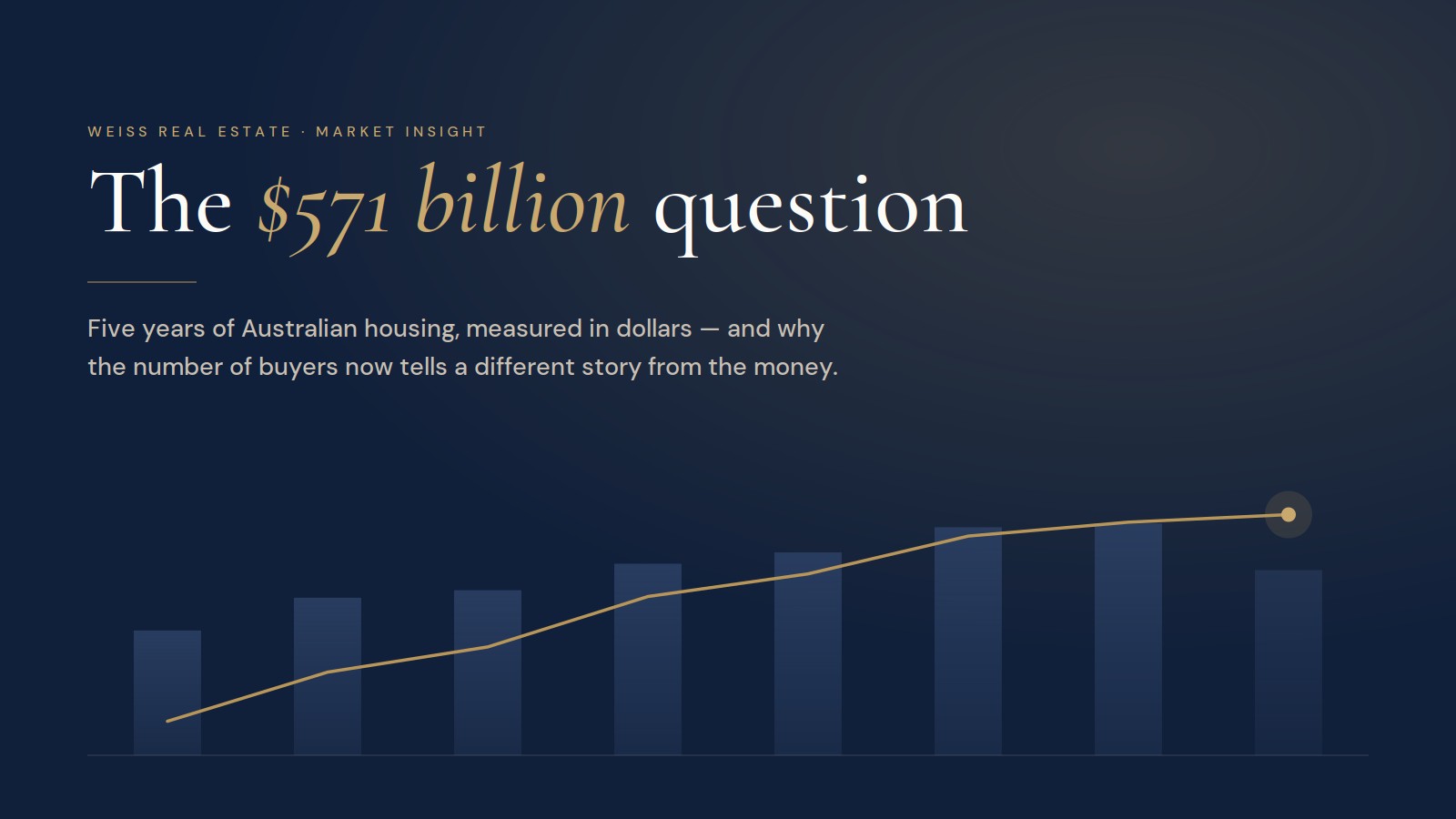
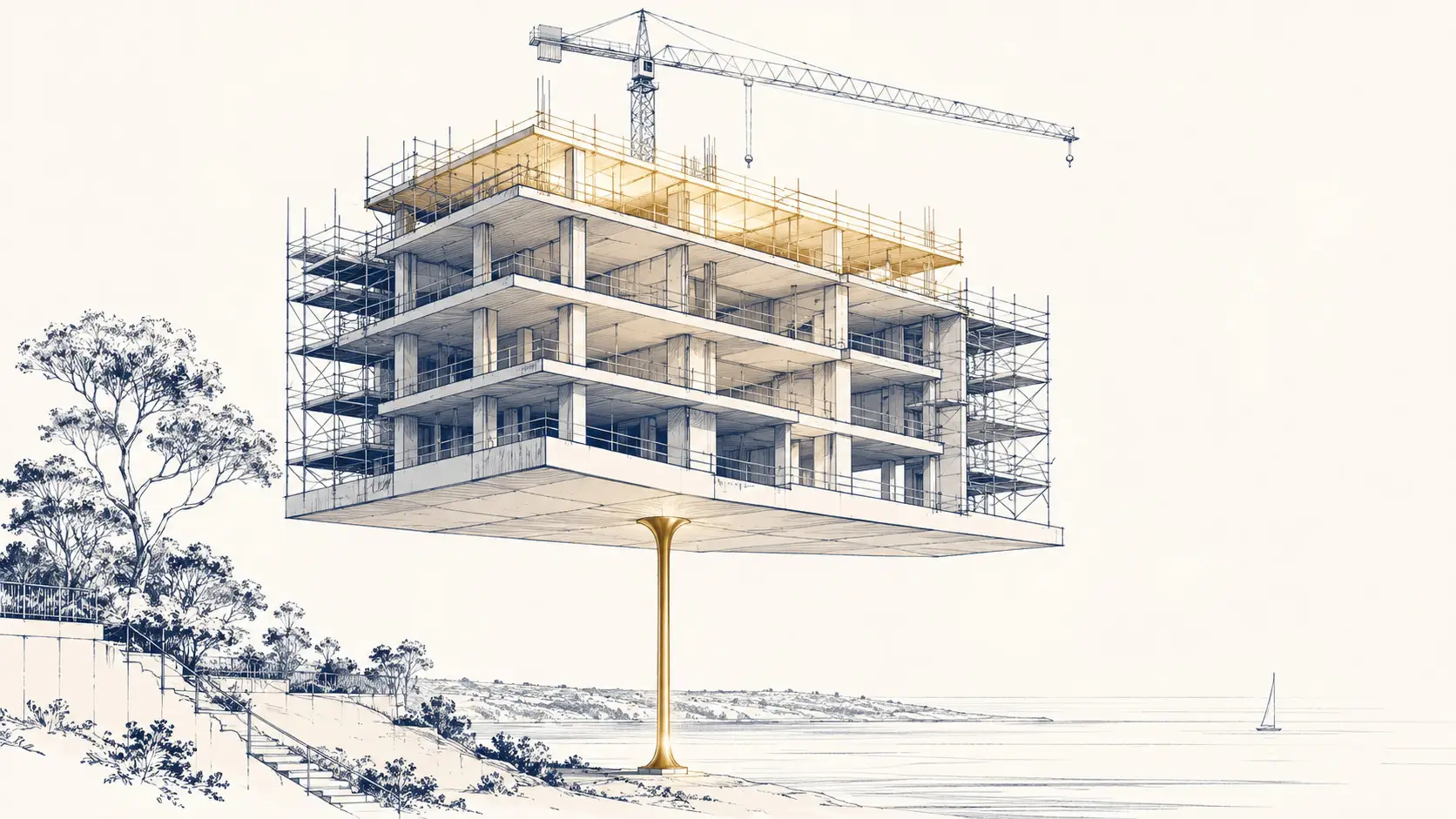
The east financed its boom on cheap money, rising valuations and a belief in bottomless demand. A rising rate, a wall of new supply and a vanished buyer are now testing every one of those assumptions — and a version of this has happened before.
Where the boom began (RBA)
Three rises in 2026 (RBA)
One Bondi Junction precinct
About 70% a year ago
It is worth remembering how cheap money felt. Through the pandemic the Reserve Bank held the cash rate at an emergency 0.1 per cent, and the effect on the Eastern Suburbs was immediate and intoxicating. Values raced. Off-the-plan apartments sold faster than you could turn your head — buyers signing on floor plans and render packs, often before a slab was poured. Anyone who paused to think found the price had moved past them by the weekend. In that heat, development sites changed hands at figures that made no sense on paper, because everyone worked from the same unspoken assumption: that the pool of buyers was bottomless, and the only mistake was not buying.
The magic money
For the people financing all this, it looked like the closest thing to a sure bet the market had offered in a generation. If land only ever rose, if apartments sold off a render, and if money cost almost nothing, then lending to a developer at 10 or 12 per cent was not risk — it was alchemy. Capital poured into development finance to chase those returns, much of it through the lightly regulated private credit funds that now sit beside the banks. A funded project could hardly fail, the reasoning ran, because a rising market would bail out any mistake before it surfaced.
That reasoning was correct — right up until the market stopped rising. An escalating market forgives almost everything. It turns an optimistic valuation into a conservative one by next quarter, covers a thin deal with the next sale, and lets a stretched project be refinanced rather than tested. Remove that single support and the others stop holding hands.
The arithmetic I watch
From the sales desk, the tell is arithmetic. Three numbers in any development must eventually reconcile: what the finished product actually sells for, what it cost to buy the site and build it, and the return promised to the money behind it. While prices climb you can leave a gap between them, because next quarter is expected to close it. When prices stop climbing, the three numbers have to meet in the present — and increasingly, on the deals I am asked to appraise, they do not. The end value no longer covers the cost plus the promised return. Something in the chain was marked too high, and it is almost always the value.
When the valuation is the asset
A great deal of the value created in that upswing was never confirmed by a buyer — it was confirmed by a valuation. A development site is valued by working backwards: take the expected end sales, subtract construction and every other cost, subtract the developer’s profit and risk margin, and what remains is the land value. Change the assumptions even slightly — a more optimistic end price, a slimmer risk margin, a shorter timeline — and the land value moves a long way. The Australian Taxation Office has warned for years that these hypothetical development valuations too often carry profit and risk margins set well below what reality would demand. In a rising market, nobody checks.
That is before the older trick, the one seasoned hands remember: a borrower who can choose the valuer will choose the valuer who returns the highest number. The work goes to whoever values the asset for the most. The modern version is more concerning still, because the parties can be the same people in different hats — the entity that lends, the entity that develops and the entity that leases sitting behind a single common interest. There is even an income-side version of the manoeuvre: where a value leans on rental income, a tenant installed at an above-market rent — often a related or obliging one — lifts the assessed figure, because a value derived from income rises with the rent. The building looks worth more; the loan against it grows; and the premium rent, like the optimistic end price, is a number chosen rather than proven.
A borrower who can choose the valuer will choose the one who returns the highest number.
None of this is a private theory. In November 2025 the Australian Securities and Investments Commission reviewed 28 private credit funds holding around $29.8 billion and found exactly these weaknesses — inconsistent valuations, related-party dealings not clearly disclosed, and distributions resting on new money rather than genuine cash. It named private credit an enforcement priority for 2026.
We have been here before
In the overheated market of 2006 and 2007, the courts were later filled with lenders suing valuers who had marked property too high. One Western Australian home carried at $1.6 million in 2007 was sold by a mortgagee for under $1 million barely three years later. Valuers are not the villains here; the courts have long accepted that a valuation is an opinion within a margin, and opinions drift upward in a rising market and are only tested when it falls. The pattern is as old as lending — the overvaluation is invisible while prices climb, and undeniable the moment someone is forced to sell.
What is different today is the plumbing. A great many developers now fund their projects not through a bank but through non-bank private credit, and where several such funds share a common interest, a loan that can no longer be serviced can be refinanced from one fund into the next, each time against a fresh and obliging valuation. That can run for a surprisingly long while. But it cannot run forever — there is always an end. And at the end, the valuation stops mattering, because the only thing that settles the question is a buyer, with real money, choosing to pay.
There is always an end — and at the end, only a buyer with real money settles the question.
The gold rush
Then the government handed the cycle a fresh accelerant. To address a genuine housing shortage, New South Wales rezoned aggressively — permitting mid-rise near transport across dozens of precincts, snap-rezoning some thirty-one locations for around 138,000 homes, and unlocking tens of thousands more around accelerated transport hubs. Good policy, and overdue. But rezoning is also found money: a site’s value can multiply the day its permissible density changes. Developers responded as they always do to found money — they raced to option sites, paying today for an upside that so far exists only on a planning map. Once again the price was a projection; once again it was being financed as though it were a fact.
The turn
The supports have now inverted, almost at once. Since the May budget and three rate rises to 4.35 per cent, the buyers who felt unlimited have simply gone quiet. Off-the-plan sales — the engine of the whole apparatus — have dried up; a purchaser who once signed off a render now waits to see the finished product, if they buy at all. Open homes that drew crowds two years ago draw a handful. The auction clearance rate sits at 51 per cent against about 70 per cent a year ago, and Cotality has Sydney values down 3.2 per cent over the June quarter, led by the premium end. Construction costs, meanwhile, never came back down.
The wall of supply
Now set that against what is coming. The same rezoning that created the gold rush is about to deliver its apartments — and it is arriving precisely as demand has thinned. Bondi Junction is the clearest case. A build-to-rent precinct of roughly 900 rental-only apartments is advancing beside the transport interchange; the council’s draft masterplan envisages around 3,000 new homes for the centre; and the rezoning around the revived Woollahra and Edgecliff stations could add up to 10,000 more nearby. Some of this is good and necessary housing. But close to a thousand rental units delivered into one precinct in a short window does not gently ease a rental market — it can flood it, softening rents and, with them, the confidence of every investor who bought on the promise of scarcity.
This is where the arithmetic turns cruel. Affordability has already thinned the buyer pool, and negative gearing has been wound back for established homes and preserved only for new builds — which channels investors toward exactly this new stock, yet a tax concession cannot rescue an entry price the market will not support. And the entry prices are steep: I have seen new apartments in and around Bondi Junction offered at rates approaching $45,000 a square metre. Ask the plain question I put to every deal — would a clear-eyed buyer, today, spending their own money, pay that and feel they had bought well? For much of the new stock, the honest answer is no. When the buyer of last resort is a tax structure rather than a person who wants to live there, the value has already been borrowed against a future that may never arrive.
| Indicator | Figure | Source |
|---|---|---|
| Cash rate, pandemic low (2020) | 0.10% | RBA |
| Cash rate now (three 2026 rises) | 4.35% | RBA |
| Sydney values, June quarter | −3.2% | Cotality |
| Homes from NSW snap-rezonings | ~138k | NSW Planning |
| Build-to-rent units, one BJ precinct | ~900 | Planning docs |
| Homes, Bondi Junction masterplan | ~3,000 | Waverley Council |
| Cost of second-tier money | ~1.5%/mo | Non-bank market |
| Sydney auction clearance, 4 July | 51% | Domain |
What China teaches
It is worth looking at where this same machinery ran furthest. China built the largest property boom in history on presales funding construction, developers leveraged to the hilt, and values booked to completion rather than to reality — at its most brazen, apartments recorded as ready to occupy while the land beneath them was still vacant, so that more debt could be raised against them. When the music stopped, the country’s largest developer defaulted in 2021 and was ordered into liquidation in 2024 carrying some US$330 billion of debt, with close to a million households left holding contracts for homes that may never be finished.
We are not China. Our market is a fraction of the scale, our lending is far better secured, and the Reserve Bank’s March review found most loans still well covered by their collateral. But the failure modes rhyme — pre-sold stock, stretched leverage, and values marked to a future that has to arrive on time. And the buyer’s response has been the same everywhere the tide went out: a flight from the promised to the proven.
The adjustment ahead
So where does that leave us? Honestly, with less visible damage than the anxiety suggests — for now. Deferral is easy while values have not fallen far enough to force anyone’s hand, and the collateral behind most loans still covers them. But the second-tier money propping up the marginal projects costs in the order of 1.5 per cent a month — roughly 15 to 25 per cent a year — and money that expensive cannot afford to wait. The moment a project can no longer refinance, the only way to prove its valuation is to sell into a market that is not there, and a forced sale is how the real number is finally discovered. My honest view is that this adjustment will run longer, and reach deeper into the development and off-the-plan corner, than the recent froth would have anyone believe. Little visible distress is not the same as little risk. It is usually what risk looks like in the quiet before it becomes visible.
What I tell owners and buyers
I sell established homes, not fund units, so let me bring this back to the sale of an actual house. The lesson of this cycle is not that the east is dangerous — it remains one of the most resilient markets on earth, and I have said so through worse than this. The lesson is to know what is holding up a price before you rely on it.
For owners: your equity is real only at the price a buyer will actually pay, not the one a recent valuation implies. If you are borrowing against it, or counting on it to fund the next move, discount the paper figure and test it against genuine settled sales — not asking prices, not withdrawn campaigns, and not the number your last refinance was struck at.
For buyers, particularly of anything off-the-plan: interrogate the valuation and the rent behind it. Ask who set the value and on what basis, whether the rent is arm’s length or arranged, and what the property would sell for today if it simply had to. In a market like this one, prefer the built and the proven to the promised — a settlement valuation that lands below the contract price is no longer a rare misfortune, and it is the buyer who wears the shortfall.
And for anyone tempted by a return that looks too generous for the risk described: it usually is. An unusually high yield is rarely a free lunch — it is a fee you are being paid for a risk that someone would prefer you did not examine too closely.
The east will be fine, in the way it always is — first to fall, first to recover, and over any sensible horizon as dependable as any market in the country. But the tide running out this year does not only lower prices. It reveals which values were real and which were merely agreed. Between here and the next upswing, the owners and buyers who do well will be the ones who knew the difference before the water dropped.
— Alan Weiss
Reserve Bank of Australia (cash rate; Financial Stability Review, March 2026); Australian Securities and Investments Commission, REP 820 Private Credit Surveillance (5 November 2025); Australian Taxation Office (guidance on hypothetical development valuations); Australian Federal Court decisions on valuer negligence arising from the 2006–07 market; NSW Department of Planning (Transport Oriented Development and rezoning programs); Waverley Council (draft Bondi Junction masterplan) and lodged planning documents (build-to-rent precinct); Cotality Home Value Index (June 2026); Domain (Sydney auction clearance to 4 July 2026); non-bank second-mortgage pricing per current market rate guides; China property downturn per public court, regulatory and media record (2021–2026). Per-square-metre pricing and forward-looking assessments are the author’s own market view. This is general market commentary, not financial or legal advice, and refers to no particular fund, lender, developer or transaction. Figures are current at the time of writing and subject to revision.