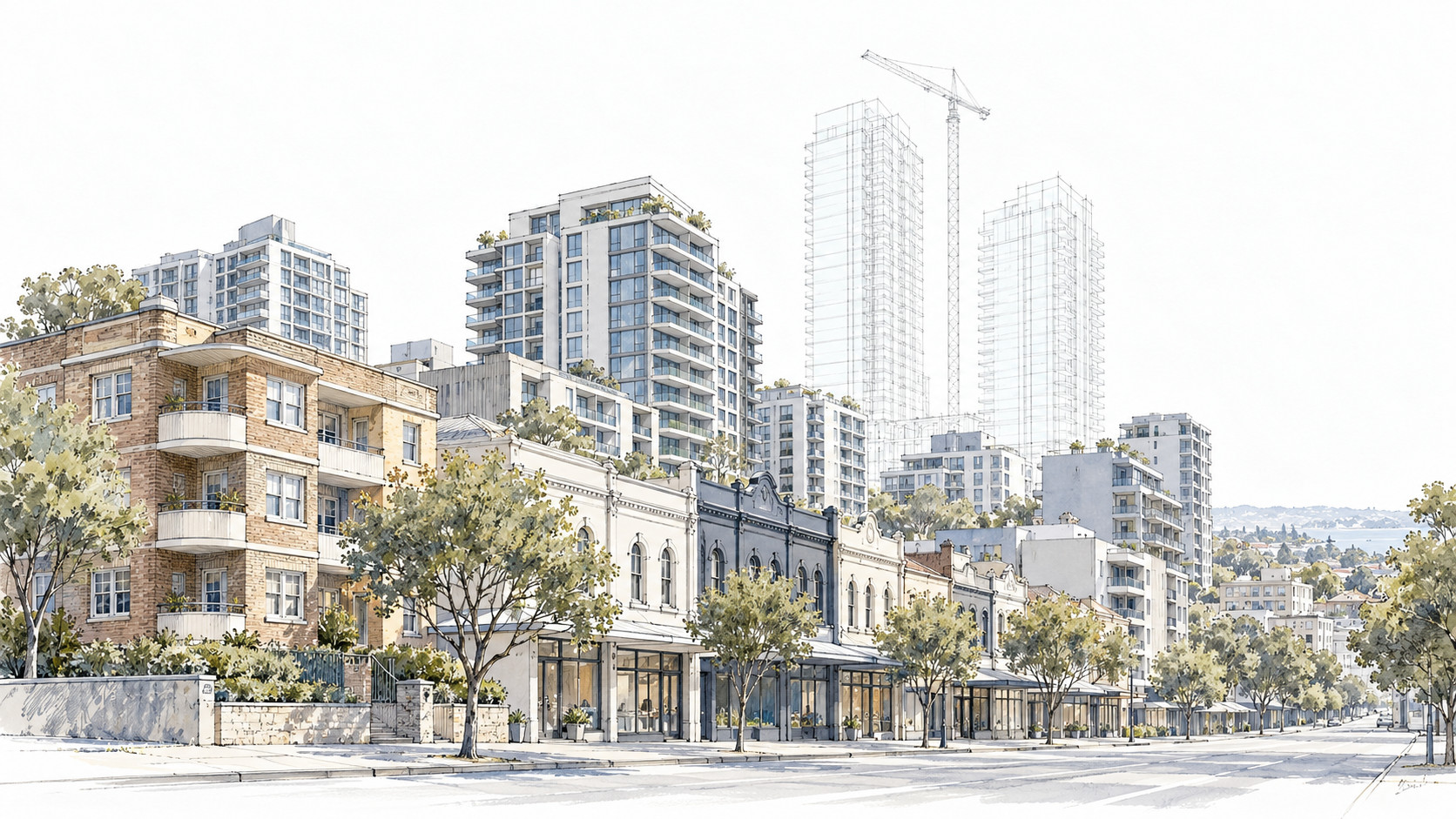
Apartment supply is finally coming to the harbourside suburbs, and more downsizers are weighing an off-the-plan purchase. It can be the right move, but it asks for diligence and a buffer. Here are the risks worth naming — and the one I’d underline.
For most of my career, off the plan was somebody else’s market. The east was built out, the stock was established, and a buyer here was choosing between houses and the odd boutique block — not a render on a hoarding. That’s shifting. With Rose Bay, Double Bay, Woollahra and Mosman now flagged as town centres, the planning settings point to a good deal more apartment stock arriving over the next three to five years, much of it aimed squarely at downsizers who want to stay local but step out of a large house.
So it’s become a real question for people I talk to, usually over a coffee: should I buy off the plan? What I want to do here is set out, plainly, what I’d think about before signing a contract for something that doesn’t yet exist. I’m not trying to talk anyone out of it. I’m trying to make sure that if you do it, you do it with your eyes open and some money in reserve.
The gap that catches people: the valuation at settlement
The trap most buyers don’t see coming is the one that arrives at the very end. When you buy off the plan, you agree a price today and settle years later — and the bank values the finished apartment at settlement, not on the day you signed. If the market has softened in between, that valuation can land below your contract price, and the bank will lend only against the lower number. Whatever’s left, you find in cash, on the day.
In a flat or falling market, I’ve watched these shortfalls run anywhere from 5 to 15 per cent on off-the-plan apartments, and they bite hardest in oversupplied pockets where some banks quietly cap how much they’ll lend. That’s worth dwelling on right now, because the wind is against this kind of bet. Cotality has Sydney’s upper-quartile values down 1.8 per cent through the March quarter, with the city as a whole sitting about 1 per cent below its November peak, and the Reserve Bank has put rates up three times this year. A contract you signed on cheerful 2025 numbers can look quite different by the time the building tops out.
And don’t lean too hard on a pre-approval. A conditional yes at signing is not a guarantee of finance two or three years later — the bank looks at you, and at the property, again at settlement, by which time rates have moved and your own circumstances might have too. Plan for settlement day, not signing day. That one habit saves more grief than any other.
You’re buying the developer as much as the apartment
The next risk has been getting worse, not better: the builder doesn’t make it to the finish line.
These numbers aren’t trivia. ASIC counted around 3,600 construction insolvencies in 2025, after roughly 3,200 the year before, and for some time now the sector has made up about a quarter of every company collapse in the country — the worst of any industry. This isn’t only small operators; firms of real size have gone down, leaving buyers with frozen deposits, lost time, and a half-built shell. Your deposit sits in trust, which helps, but if a developer folds mid-build you can be in for a long, uncertain wait — and in the worst case a refund that hands you back to a market that has since moved on without you.
I’m not raising this to frighten anyone off. The point is simply that the people behind the project matter as much as the floor plan — their track record, whether they’re financially sound, and whether you can walk through buildings they’ve already finished. That’s the homework, and it isn’t optional.
“New” doesn’t mean “sound”
Here’s the part of the conversation nobody enjoys, so I’ll be plain about it. A brand-new apartment is not automatically a good one. The most recent Building Commission NSW research found serious defects in the common property of 53 per cent of strata buildings registered between 2016 and 2022 — up from 39 per cent two years earlier — with waterproofing and fire safety the usual culprits. UNSW’s researchers have put the share of buildings carrying at least one significant defect higher still, with the average repair bill running well into six figures per building.
In fairness — and this matters — the same research shows defects in newer buildings trending down since 2020, and the rules now have teeth they lacked a decade ago. Building Commission NSW can order a developer to fix serious defects for up to ten years after completion; statutory warranties run six years for the major items and two for the rest; and there’s a compensation scheme behind that. It’s a far better regime than the one that produced the Opal and Mascot Towers headlines. But better odds aren’t a guarantee, and a regulator’s backstop is no substitute for checking who’s building your home before you buy it.
Sunset clauses: read them, don’t trust them
Every off-the-plan contract has a sunset clause — a date by which the project must finish, after which either side can walk away. In a rising market a few developers have played games with these: dragging construction out to trip the clause, cancel your contract, and re-sell at a higher price. NSW has since closed much of that door — a developer generally can’t tear up the contract under a sunset clause without your written consent or a Supreme Court order. Useful protection. Still no excuse to skim the document. Get a good solicitor across the sunset clause, the variation clauses and the finishes schedule before you sign, because what you’re shown in the display suite and what’s actually enforceable in the contract aren’t always the same thing.
The one I’d underline
If you remember nothing else, remember this: don’t let an off-the-plan purchase hang on what your current home will sell for.
It’s the most natural plan in the world, especially for a downsizer. Sign for the apartment now, sell the family home nearer to settlement, use the proceeds to complete. In a rising market it generally works out. In this one it can squeeze you from both ends.
Think about how the timing actually sits. The price on your contract is fixed and the settlement date belongs to the developer, not to you. The sale of your home is neither fixed nor on your schedule. If prices have eased by the time you go to sell — and the prestige east is easing, with Bellevue Hill down around 5.5 per cent over the year and the upper quartile falling — the equity you were counting on may not be there. You can end up selling your home into a soft market on someone else’s clock, or carrying costly bridging finance to span the gap, or doing both at once. And if the new apartment also values short at settlement, you’re wearing a shortfall on one side while taking less than you hoped on the other. I’ve seen that vice close on people, and it isn’t pleasant.
So the rule I’d give you is simple. Don’t sign a contract whose completion depends on an uncertain future sale at a price you’ve assumed. Either you can settle without selling your home, or you sell first — or, at the very least, you go in with a conservative figure on your own property, proper finance advice, a genuine cash buffer, and a clear plan for the gap between the two settlements. Hoping your home fetches a good number in two years is not a plan.
What I’d recommend, in short
Buy the developer and the builder, not just the apartment, and walk through something they’ve finished before you commit. Have a solicitor read the contract properly — sunset and variation clauses included. Stress-test your money for settlement day, with enough in reserve to absorb a valuation coming in 5 to 15 per cent light. Pay for a proper pre-settlement defects inspection. Don’t tie the purchase to your home’s future sale price. And be honest with yourself about whether an established apartment — one with real comparable sales and a building you can stand in today — gives you a certainty that’s worth more, in a market like this, than the shine of something new.
Off the plan can be exactly the right move for the right buyer. But it asks for diligence and a buffer, and it’s unforgiving of optimism — never more so than when the market is drifting down. If you’re weighing one up, that’s the kind of decision worth talking through before you sign, not after.
Alan Weiss is the principal of Weiss Real Estate, a strategy-led practice serving Sydney’s Eastern Suburbs since 1990. 0412 176 074 · alan@weissrealestate.com.au
This article is general commentary, not financial or legal advice; please obtain your own solicitor’s and finance professional’s advice before signing any contract.