
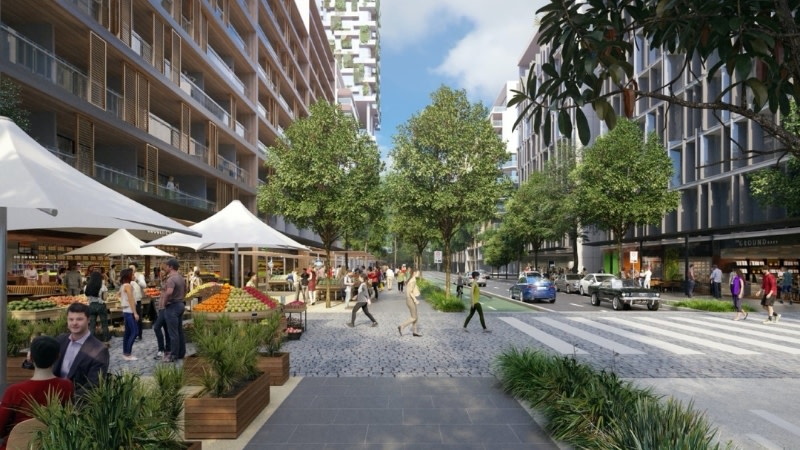
The Waterloo redevelopment should not be looked at as one isolated building project. It is part of a much larger shift in how New South Wales is dealing with public land, public housing, private development and density.
The numbers tell the story.
The Waterloo South renewal is planned to deliver about 3,300 new homes. According to City West Housing, the consortium expects at least 50% of the project to be social or affordable housing: roughly 1,000 social homes, more than 600 affordable homes, and approximately 1,500 private market dwellings.
On paper, that sounds like a strong housing outcome. But when you look more closely, the important question is not only how many homes are being built. The real question is: what type of housing is being replaced, who gets to return, and how much of the final project remains genuinely available to people who cannot survive in Sydney’s private rental market?
What the Housing Terms Actually Mean
Social housing is subsidised rental housing for people on low incomes or in vulnerable circumstances. In NSW, social housing tenants generally pay rent based on income, often around 25% to 30% of household income, rather than market rent. Social housing includes public housing, community housing and Aboriginal housing.
Public housing is the traditional government-owned and government-managed housing model. In NSW, it is managed by Homes NSW, which was established in February 2024 as a division of the Department of Communities and Justice.
Community housing is social housing managed by registered not-for-profit housing providers. It may still be part of the social housing system, but it is not the same as old-style government-managed public housing.
Aboriginal housing is social housing provided through Aboriginal housing programs, including housing managed by the Aboriginal Housing Office and Indigenous community housing providers.
Affordable housing is different again. It is usually rented below market rent, often aimed at moderate-income workers who cannot afford private rents in expensive locations. It is not necessarily affordable to people on very low incomes.
Market-rate dwellings are ordinary private apartments sold or rented at full market value. In a location like inner Sydney, that means pricing will be driven by land value, construction costs, investor demand and buyer competition.
That is why the Waterloo numbers matter. A project can increase the total number of homes and still reduce the proportion of traditional public housing.
NSW’s Social Housing Portfolio: The Bigger Picture
NSW has about 156,000 social housing dwellings across public housing, community housing and Aboriginal housing. The Audit Office of NSW describes social housing as housing for low-income households and confirms that NSW’s system includes public housing, community housing and Aboriginal housing.
If we look specifically at government public housing, Homes NSW says its maintenance priority covers about 95,000 public housing properties across the state.
The Australian Institute of Health and Welfare reported that at June 2024, NSW had the highest number of public and community housing dwellings in Australia: about 94,500 public housing dwellings and 54,400 community housing dwellings. NSW also had the largest number of Indigenous community housing dwellings, around 6,500.
These numbers show the scale of the system. They also show why the issue is so difficult. NSW is not dealing with a small portfolio. It is managing one of the largest social housing systems in the country, much of it old, heavily used and under pressure.
Where the Housing Is Located
Social housing in NSW is not evenly spread. The largest concentrations are in Sydney’s established metropolitan areas.
AIHW data shows that in 2024, some of the highest social housing concentrations in Australia were in Sydney regions, including Sydney–Parramatta with about 14,300 dwellings, Sydney–City and Inner South with about 14,100 dwellings, and Sydney–Inner South West with about 13,600 dwellings. At the local government level, City of Sydney had about 11,200 social housing dwellings, Canterbury-Bankstown had about 10,500, and Blacktown had about 10,300.
That helps explain why Waterloo is so significant. Waterloo sits inside the Sydney City and Inner South housing belt, close to the CBD, transport, hospitals, universities and employment. These are exactly the locations where social housing is most valuable socially, but also where the land is most valuable commercially.
That is the conflict.
Public housing land in Waterloo is not just housing land. It is inner-city land. And once that land is redeveloped into a mixed private and social housing precinct, the character of the estate changes permanently.
What Type of Homes Are in the Social Housing System?
Across Australia, public housing is still largely made up of traditional family-style stock. AIHW reports that at June 2024, public housing dwellings were mainly separate houses at 36%, flats, units or apartments at 35%, and semi-detached, row or terrace housing at 28%. Community housing was more apartment-based, with 51% flats, units or apartments, followed by 29% separate houses.
This matters because Waterloo represents the future direction of many inner-city public housing sites. Older low-rise estates are being replaced with apartment towers and mixed-tenure communities. That may increase the number of dwellings, but it also changes the type of housing, the density, the ownership structure and the long-term feel of the neighbourhood.
The Condition Problem
The condition of NSW public housing is one of the biggest issues sitting underneath this debate.
Homes NSW now says its priority is to maintain about 95,000 public housing properties to a standard that ensures safety, belonging and privacy. It has introduced a new maintenance model, including a Maintenance Hub, online repair requests and new maintenance contractors.
But the scale of the repair problem is enormous. The NSW Government announced a $1 billion Repair and Restore maintenance blitz to fix 30,000 public homes in desperate need of repair.
That one number is critical.
If 30,000 public homes need major repair attention, then the debate about Waterloo cannot simply be reduced to “old buildings versus new buildings.” The real issue is that NSW has allowed parts of its public housing portfolio to age to the point where renewal becomes the political answer.
There is also an administrative problem. The Audit Office found that in June 2024 there were about 56,332 households waiting on the NSW Housing Register, including 46,904 general applicants and 9,428 priority applicants. More than 6,000 applicants had been waiting over 10 years.
That is the harsh reality. NSW is not only short of housing. It is short of suitable housing, in the right places, in acceptable condition, with a system that can allocate homes quickly and fairly.
Why Waterloo Matters
Waterloo is being sold as a renewal story. And in some ways, it is. More dwellings. New parks. New community spaces. New buildings. Better amenity.
But from a property and planning perspective, I see something deeper.
Waterloo is the blueprint for how inner-city public housing land may be treated in the future. The government retains a social housing component, introduces affordable housing, then uses private market housing to help make the redevelopment work financially.
That may be practical. But it is not the same as simply rebuilding public housing.
The question should be asked plainly:
Are we increasing public housing, or are we replacing public housing estates with mixed private apartment precincts?
Because those are two very different outcomes.
My View
Sydney needs more housing. That is not in dispute.
But numbers alone do not tell the full story.
A project that delivers 3,300 new homes sounds impressive. But when only part of that housing is social housing, and another part is affordable housing, and the balance is market-rate private apartments, the public needs to understand exactly what is being gained and what is being lost.
In Waterloo, the government is not just building apartments. It is reshaping a whole inner-city community.
And when NSW already has around 156,000 social housing dwellings, about 95,000 public housing properties under Homes NSW maintenance responsibility, more than 56,000 households waiting for social housing, and 30,000 public homes requiring major repair investment, Waterloo becomes more than a redevelopment.
It becomes a test case.
The test is whether NSW can renew ageing public housing without losing the very purpose public housing was created for in the first place.
That is the number that matters most.
