Feasibility study · August 2026
Downsizing into a falling market:
swap now, or wait three years
A Dover Heights owner is trading a four-bedroom house worth $7.5 million for a three-bedroom apartment of 150 square metres or more — the same money, near enough. But the apartment market is heading into oversupply, and the decline is expected to fall hardest on exactly the luxury stock they intend to buy. The house sells either way. The only question worth modelling is when they buy the unit.
01 — The two paths
Same house sold. Different timing.
Path A — Swap now
Sell the house for $7.5 million. Buy the $7 million apartment immediately, pay the duty, move in. Hold it for three years while the apartment market corrects. Carry strata, council and water throughout.
Path B — Sell, bank, rent, wait
Sell the house for $7.5 million. Place the proceeds on term deposit. Rent a luxury apartment of equivalent standard at $3,100 per week. Buy the same apartment in three years, after the correction.
House sale
Less 2.0% costs — net $7,350,000
Target apartment
3-bed, 150sqm+, at today’s price
Duty on that purchase
NSW premium duty, 2026–27
Deposit rate
Blended term-deposit ladder
Marginal tax
Top rate including Medicare levy
Rent while waiting
$3,100 per week, rising 4% annually
Strata, rates, water
Per year, if the unit is owned
Horizon
Both paths measured at the same date
The first finding, before any market movement
The swap is not equal money. A $7.5 million house sold at 2.0% costs nets $7,350,000. A $7 million apartment plus $414,000 in duty, $8,000 in legals and $20,000 to move costs $7,442,000. The downsizer is $92,000 short before they have gained a single thing. Duty is the quiet cost in a house-for-unit trade at this level, and it is charged at $7 per $100 above $3,870,000 — so it scales brutally with the purchase price.
02 — The comparison
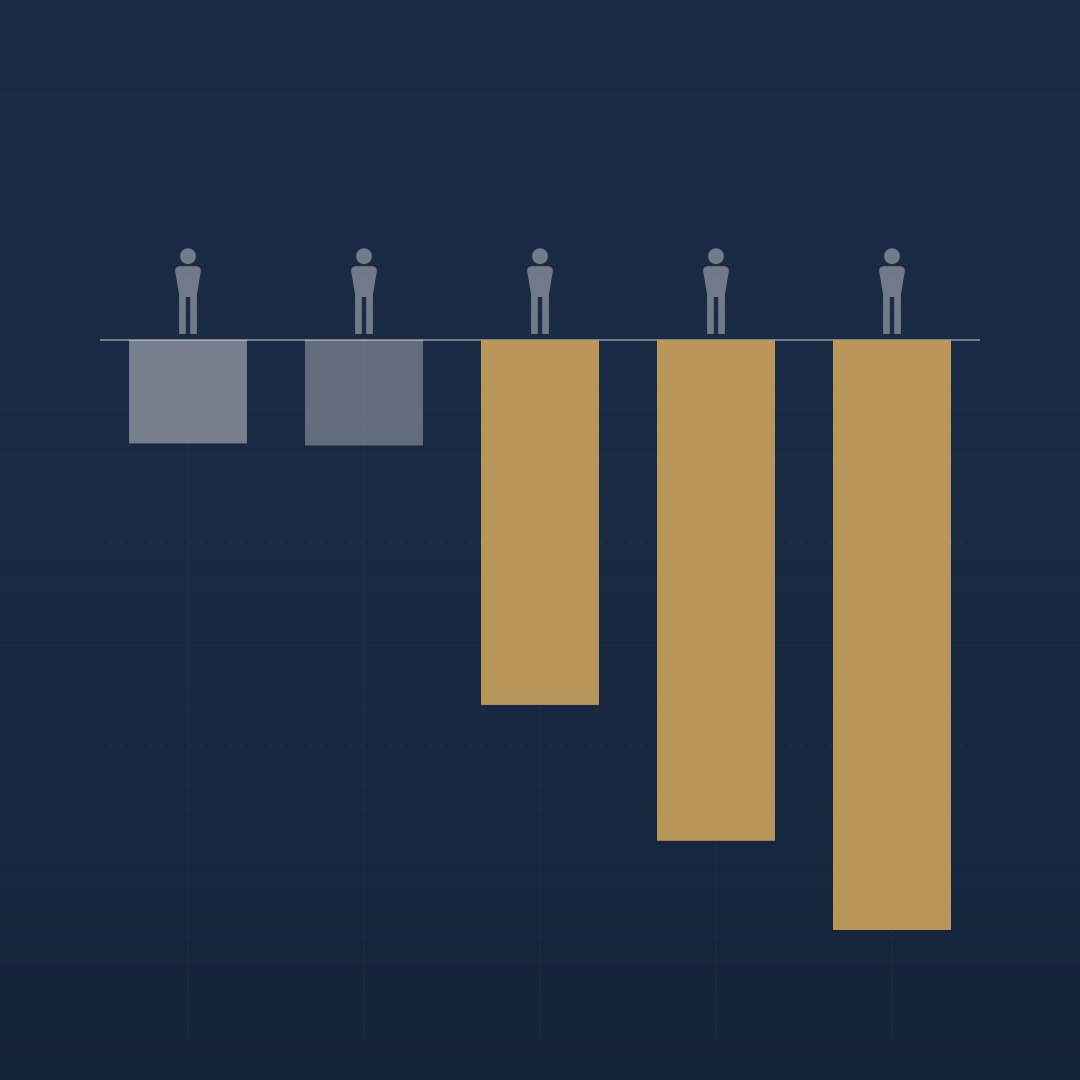
Net position after three years
The shape of that chart is the whole argument. Path A is a staircase down: the owner holds a depreciating asset and every percentage point of decline comes straight off their net worth. Path B is almost flat, and tilts upward as the market falls — because the money is sitting in cash while the thing they intend to buy gets cheaper.
In a falling market, the buyer who has not yet bought is the one holding the advantage.
03 — The numbers
Position at three years, side by side
| Apartment decline | Path A — swap now | Path B — rent and wait | Advantage of waiting | Cash left over, Path B |
|---|---|---|---|---|
| No decline | $6,790,546 | $6,990,012 | $199,467 | –$9,988 |
| –5% | $6,440,546 | $7,014,512 | $573,967 | $364,512 |
| –10% | $6,090,546 | $7,039,012 | $948,467 | $739,012 |
| –15% | $5,740,546 | $7,063,512 | $1,322,967 | $1,113,512 |
| –20% | $5,390,546 | $7,088,012 | $1,697,467 | $1,488,012 |
The two shaded rows are the expected range. At a 10% correction the downsizer who waited is $948,467 ahead and holds $739,012 in cash they would not otherwise have. At 15%, they are $1,322,967 ahead with more than $1.1 million liquid. They live in the same apartment either way.
The row worth studying closely, though, is the first. Even if apartment prices do not fall at all, waiting is $199,467 better. That is not a market call — it is simply three years of strata and rates avoided ($117,454), plus a modest cash surplus after tax and rent. The downside case for waiting is not a loss. It is a smaller gain.
04 — Where the money goes
Three years of cash flow, Path B
Interest earned
Over three years at 5.00%
Tax paid
At the top marginal rate of 47%
Rent paid
Three years, escalating at 4%
Net cash surplus
After tax and after rent
This is the honest part of the story. After tax and rent, the cash strategy generates $82,012 across three years — around $27,000 a year on a $7.3 million balance. Nobody should do this for the interest. The interest merely pays the rent and leaves a little change. The return is in the purchase price, not the deposit rate.
Duty compounds the effect. A $7 million apartment attracts $414,000 in transfer duty. The same apartment at 15% less costs $5,950,000 and attracts $340,500 — a further $73,500 saved simply by transacting at a lower number. The State takes 7 cents in every dollar above $3,870,000, which means a falling market discounts the tax bill as well as the asset.
05 — Why the decline is likely to be steeper in apartments
The oversupply loop
The reason this analysis exists is a feedback loop, and it is worth stating plainly. As more Eastern Suburbs owners reach the same conclusion — that a large house is more than they need — they list the house and go looking for a premium apartment. That adds houses to one market and demand to another. But apartment completions are also arriving, and prime three-bedroom stock above 150 square metres is a narrow, illiquid segment with a small buyer pool.
When that segment softens, it does not soften gently. Discretionary buyers withdraw, vendors who have already committed elsewhere are forced to meet the market, and the recorded sales that follow reset the comparable evidence for everyone. That is the mechanism by which luxury apartments fall further and faster than houses in the same postcode. My own view is that the risk is skewed to the downside here, and a downsizer who buys into it at today’s prices is taking that risk with the entirety of their capital.
06 — Risk
What would have to go wrong
The correction may not come
This is the central assumption and it is a forecast, not a fact. The consolation is the first row of the table: even at zero decline, waiting is modestly ahead. Apartment prices would need to rise roughly 3% over three years before swapping now becomes the better decision.
Deposit rates will not hold
The RBA cash rate sits at 4.35%, the top of a tightening cycle that ran through 2026. If rates fall to 3%, the after-tax income no longer covers the rent and the capital begins to erode. Laddering term deposits out to twelve months locks part of the return, not all of it.
The tiering trap
Macquarie’s savings account pays 5.00% only on balances to $2 million; above that it drops to 2.75%. Depositing $7.3 million into one savings account blends to roughly 3.3% and erases the surplus entirely. A term-deposit ladder is a requirement, not an optimisation.
Deposit concentration
The Financial Claims Scheme guarantees $250,000 per person per institution. At $7.3 million with one bank, roughly 97% of the capital is unguaranteed. Spreading across three or four authorised deposit-taking institutions costs a few basis points and should be treated as the price of prudence.
Three years is a long time to rent
Two lease terms, two renewal negotiations, and a landlord who can decline to renew. Prime Double Bay stock of this calibre is thin. The strategy requires a tenancy that is secure enough to be lived in comfortably, which argues for a longer initial term negotiated up front.
Discipline at the far end
A correction does not announce itself. It appears in particular buildings, in particular circumstances, often briefly. The owner must be watching, liquid and decisive at the moment it arrives — and willing to buy something slightly different from what they pictured three years earlier.
Assessment · Alan Weiss
My read on it
Downsizing is usually sold as a lifestyle decision, and the timing is treated as incidental. In this market it is the opposite. The lifestyle outcome is identical in both paths — the same apartment, the same street, the same lift. The only variable is what the owner pays for it, and whether they are holding cash or bricks while the price is being decided.
What persuades me is not the 15% case. It is the zero case. If apartment prices simply flatline, the owner who waited is still ahead by about $200,000, because they have not paid three years of strata and rates on an asset going nowhere. The strategy does not need the forecast to be right. It only needs the forecast not to be badly wrong in the other direction.
The part I would not gloss over is that this asks a lot of the person doing it. It means selling a family home and renting for three years with no certainty about the far end. That is not a small thing to ask of someone in their sixties or seventies, and I would not push it on anyone who found the prospect distressing. But for an owner who is unsentimental about it, the arithmetic is not close. You are being paid roughly a million dollars to be patient.
This is a feasibility model, not financial advice. The tax treatment in particular deserves a proper look — splitting the interest across two names, where one is not at the top rate, is worth more than any point of deposit rate. Review it with an accountant and a licensed adviser before acting.
Sources and assumptions
Cash rate — RBA, 4.35%, effective 17 June 2026.
Deposit rates — Macquarie Bank: savings 5.00% p.a. to $2,000,000 and 2.75% above; 12-month term deposit 5.20% p.a. at maturity. Current August 2026, variable.
Deposit guarantee — Financial Claims Scheme, $250,000 per account holder per authorised deposit-taking institution.
Transfer duty — Revenue NSW, 2026–27. Premium threshold $3,870,000, charged at $7.00 per $100 of the excess. Figures here are estimates; confirm with the Revenue NSW calculator.
Tax — 47% including Medicare levy. Main residence exemption assumed to apply in full to the house sale.
Rent — $3,100 per week as briefed, escalating 4% annually. Confirm the current asking rent on the specific apartment before relying on it.
Selling costs — 2.0% of sale price, covering fee, campaign and legal.
Apartment values and the decline range — the $7,000,000 target and the 10–15% decline scenarios are Alan Weiss’s own assessment of Eastern Suburbs prime apartment stock, not published forecasts. They should be tested against comparable evidence before any decision.