
Building analysis · The Oscar, Bondi Junction
One address, six price brackets
What 59 sales inside The Oscar reveal about the limits of a suburb median.
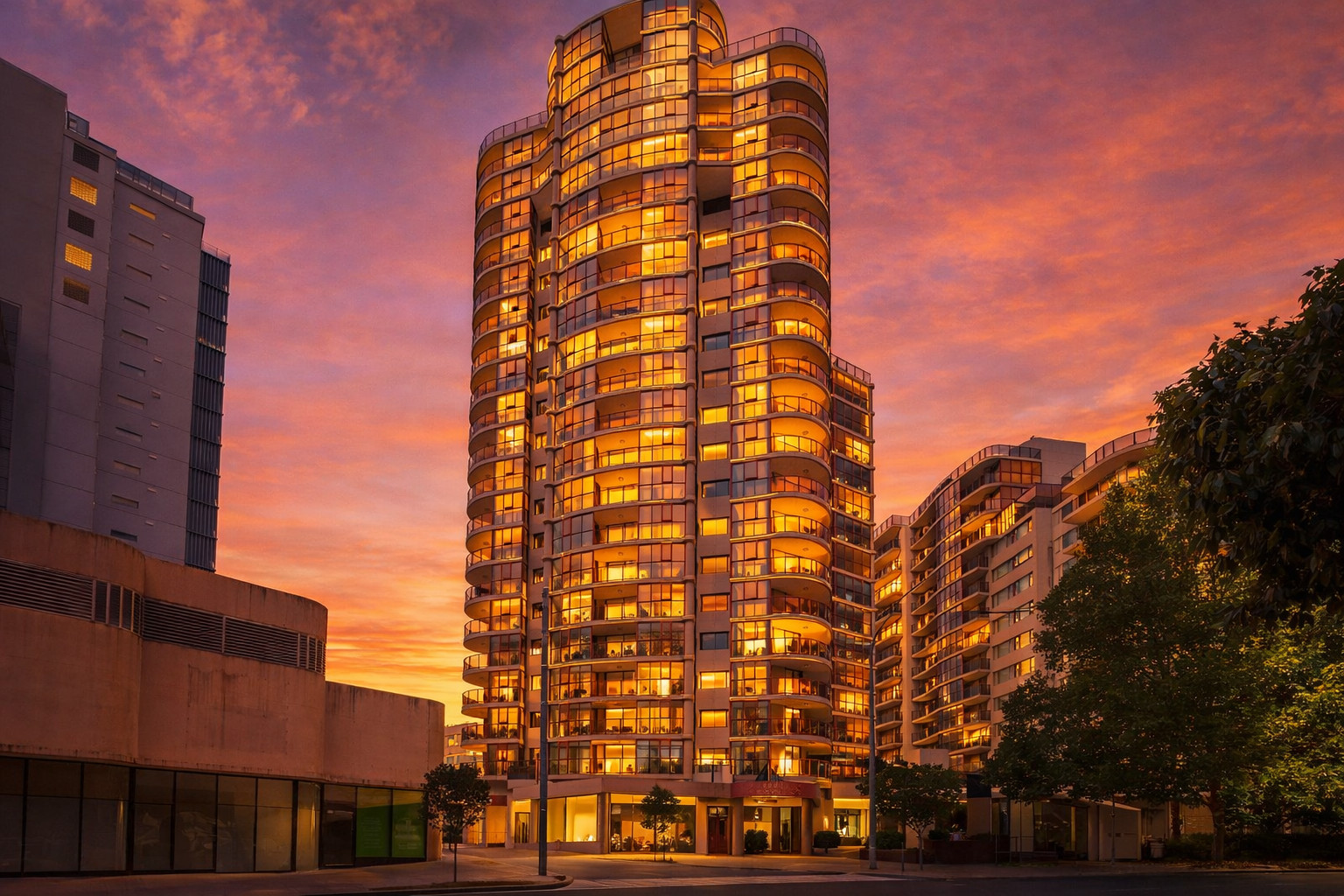
Most people describe an apartment by its suburb. Buyers do it, sellers do it, and the portals encourage it. But the further I get into transaction records, the more I find that the suburb is the least useful unit of analysis available. The building matters more. And inside a building of any real size, the apartment matters more still.
I've been through the sales register for The Oscar — the Meriton complex at 2A Hollywood Avenue and 18-34 Waverley Street, Bondi Junction. The first thing worth saying is that these are not two buildings in any legal sense. Both frontages sit under the same strata plan. Two towers, interconnected, rising to 21 levels, roughly 180 to 190 apartments, completed in 1995. The market treats them as separate addresses. The title does not.
The second thing is the spread. Across 59 verified residential sales, prices run from $800,000 to $4,800,000. A sixfold range — same lobby, same levy notice, same building manager.
The ladder
Plotted from lowest to highest, the sales form a continuous ramp rather than the stepped pattern you might expect.
Sales ranked lowest to highest
Source: title exports for The Oscar (SP50442), Bondi Junction. Excludes one commercial lot, one undisclosed price and three records carrying other strata plans.
That smoothness is the point. There is no cliff between the one-bedroom band and the two-bedroom band, no obvious break where three-bedroom stock begins. Aspect, level, outlook, parking and the condition of the kitchen do as much work as the bedroom count. An apartment on a high floor facing north can sit above a larger one facing a lightwell four levels down.
The two sales at the top — $3,500,000 and $4,800,000 — sit well clear of the next result at $2,530,000. They are adjacent lot numbers and almost certainly reconfigured or amalgamated stock rather than standard floorplates. They also drag the average to $1,560,299 against a median of $1,420,000, which is a useful reminder of why I don't quote averages.
The bands
Grouped into price brackets, the distribution is flatter than most people assume.
Sales by price band
Source: title exports for The Oscar (SP50442), Bondi Junction. Bands are analytical groupings, not bedroom classifications.
Twelve sales under $1,000,000. Twelve between $1,000,000 and $1,300,000. Twelve at or above $2,000,000. The middle is broad rather than dominant.
The median of $1,420,000 describes almost nobody. It is a statistical midpoint, not a typical apartment.
An owner reading a suburb median — or even a building median — and applying it to their own apartment is working from a number that has very little to do with them. In a scheme this size, the median is a starting point for a conversation, and a poor one.
The two frontages behave the same
Hollywood Avenue records a median close to $1,470,000 across 42 sales, Waverley Street $1,390,000 across 17. The apparent difference in spread between them is a function of sample size, not of the buildings. I wouldn't put weight on it.
What 1995 actually bought
The complex was built in a period that priced space differently. Developers were working to floorplates that assumed a resident would live there for years rather than cycle through on a two-year lease. Kitchens had bench runs. Bedrooms took a wardrobe and a bed and still had floor left. Balconies were sized for a table.
That is not nostalgia — it is the reason this stock keeps trading. New apartment product in the Bondi Junction precinct is being delivered at a rate per square metre that makes a genuinely large three-bedroom apartment extraordinarily expensive. An owner-occupier who wants 120 square metres and a car space has a much shorter list of options in new stock than in 1990s stock, and that list gets shorter as the current development pipeline delivers smaller average floorplates.
So the buyer competition for the larger apartments in a building like this one comes from two directions at once: local downsizers who have decided against new, and families who cannot buy a house in the postcode. That is a durable demand position, and it shows in the upper half of the ladder.
On growth
This is where I want to be careful. The register I've worked from carries prices but no sale dates, which means I can state the distribution with confidence and cannot state a growth rate at all. Anyone quoting a capital growth figure for a specific building without a dated repeat-sales series is estimating, and I'd rather say so than publish a number I can't stand behind.
What I can say is structural. Buildings of this vintage in this precinct have generally held value better than the 2015–2022 investor-grade stock around them, for the floorplate reasons above. Whether that has translated into 3 per cent a year or 6 per cent inside this particular scheme is a question I'll answer properly once I've pulled the dated repeat-sales record — and I will, because it's the number that actually matters to an owner deciding whether to hold.
If you own one of these
Three things follow from the data.
Your apartment is not the median
It sits somewhere on a ladder that runs six times from bottom to top, and where it sits is determined by things a portal estimate cannot see — which way it faces, what floor it's on, whether the kitchen was done in 2006 or last year, whether it has one car space or two.
Your own building is the comparable set
Sales inside your own scheme are worth more than sales across your suburb, and there are enough of them here to build a genuine case.
Presentation is not a rounding error
The gap between a well-presented apartment and an average one in a scheme this size is not a few per cent. Looking at the ladder, it is frequently $200,000 or more between apartments that are, on paper, the same thing.
Same lobby, same levy notice, same building manager — and six different markets trading under one roof.
Weiss Real Estate
Where does your apartment actually sit?
I read the sales inside your own building before I read the suburb. If you own in Bondi Junction and want to know which rung of the ladder you're on — and what it would take to move up one — I'm happy to sit down and go through it.
Methodology. 64 records were supplied across two title exports covering The Oscar, 2A Hollywood Avenue and 18-34 Waverley Street, Bondi Junction. Excluded from the analysis: one commercial retail lot, one undisclosed price, and three records carrying strata plans other than SP50442. The remaining 59 residential sales form the basis of every figure above. Building details — Meriton, 1995 completion, two interconnected towers, 21 levels, approximately 180 to 190 apartments — are as understood at the time of writing and should be confirmed against the strata roll. No sale dates were available, so no growth rate, hold period or trend has been calculated or implied.
This article is general commentary on the Eastern Suburbs property market and does not take account of any individual's circumstances, objectives or financial position. It is not financial, legal or investment advice. Property values move, and past sales are not a reliable indicator of future results. Alan Weiss, Weiss Real Estate — Licence 218396, independent contractor for eXp Australia.