There’s a story playing out across Sydney right now, and it’s becoming more common by the month. Parents stepping in to help their children buy property. Not with small assistance, but with serious capital — sometimes $300,000, $500,000 or more. On the surface, it feels like the right thing to do. It gives the next generation a foothold in a market that feels increasingly out of reach. But when you strip it back and look at the numbers, the decision becomes far more complex than simply “helping them get in.”
Take a real scenario I was asked to assist with. A young couple, combined income of $220,000, one child, looking to buy a $2 million apartment in Maroubra. A solid, established unit with a good layout, but one that requires a full renovation — kitchen, bathrooms, flooring, paint. The parents are prepared to contribute $500,000 to make it happen.
At first glance, it looks like a strong position. A healthy deposit, good income, and a clear path into a blue-chip suburb. But the moment you step into the financial modelling, the picture starts to shift.
The first point most families overlook is that $500,000 in cash is not just $500,000. This is after-tax money. If the parents accumulated that capital through income, they may have had to earn close to double that amount depending on their tax bracket. If the funds are coming from investments, there is a loss of compounding. If it’s borrowed against their own property, there is an ongoing cost. At a modest 6 percent, that $500,000 effectively costs around $30,000 per year just to hold. That’s before the young couple even starts paying their own mortgage.
Then comes the true cost of the purchase. A $2 million property in New South Wales carries stamp duty of roughly $92,000. Add legal costs, acquisition expenses, and a realistic renovation budget, and suddenly the real entry cost is not $2 million — it’s closer to $2.2 million. This is the number that matters, because that’s the capital being committed.
Once the deal is structured, the loan required is no longer just the purchase price minus the deposit. After costs, the borrowing requirement pushes closer to $1.5 million or more. With current lending conditions, banks are assessing borrowers at rates well above what they actually pay, often around 8.5 to 9 percent. With a dependent child in the picture, borrowing capacity tightens further. This is where many buyers are surprised — income alone does not determine borrowing power. The system is designed to test how much pressure the household can withstand, not how optimistic the scenario looks.
If the loan settles around that level, the repayment profile becomes significant. Mortgage repayments alone can sit around $110,000 to $120,000 per year. Add strata levies, council rates, water, insurance, and ongoing maintenance, and the total cost of holding the property can easily reach $130,000 to $140,000 per year. When compared to renting an equivalent apartment at approximately $1,300 per week, or about $67,000 per year, the gap becomes very clear. The cost of owning is almost double.
This is where the real question begins. Not whether they can buy, but what they are actually buying into.
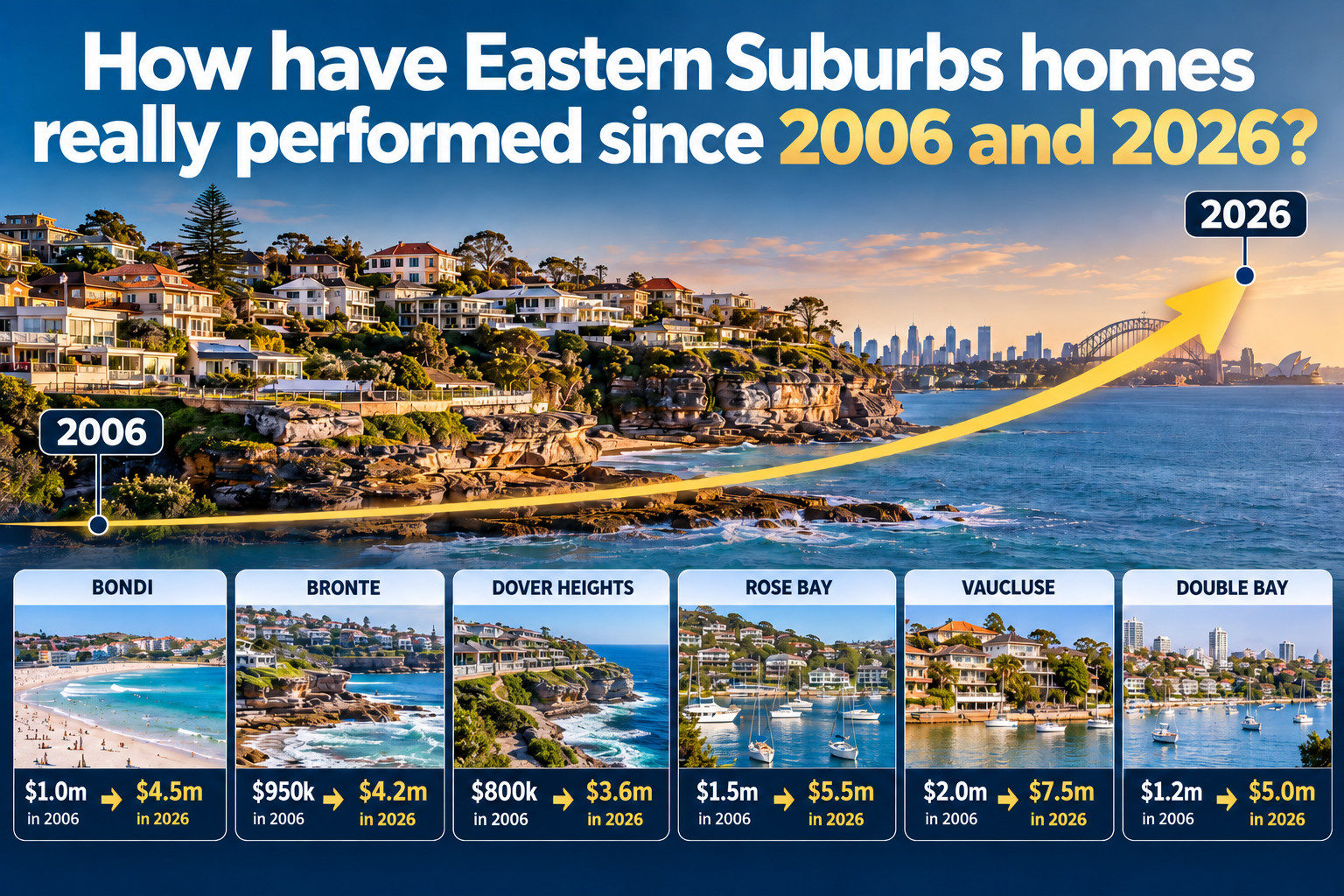
Property has historically been seen as a long-term wealth builder, and in many cases it has been. But that outcome depends heavily on the timing of entry and the conditions of the market. The last decade was unusual. Interest rates fell to historic lows, buyer confidence surged, and supply struggled to keep up. That created strong capital growth, particularly in Sydney’s eastern suburbs.
The environment today is different. Interest rates are higher, borrowing capacity is tighter, and there is a coordinated push to increase housing supply. Government policy is actively encouraging more apartments, more density, and faster development approvals. While supply does not always translate immediately into price declines, it does change buyer behaviour. It introduces more choice, more competition, and often more price sensitivity.
We have seen this before. There have been periods in Sydney where property prices have remained flat or even declined for several years, particularly in segments with heavy new construction. In those environments, the assumption of steady growth does not hold. Instead, owners carry the cost while waiting for the market to catch up.
If we project this scenario forward over seven years, the outcome becomes highly dependent on growth. If the property grows at two percent per year, the capital gain may not be enough to offset the additional cost of ownership compared to renting. At three percent, it becomes marginal. It is only when growth reaches four to five percent per year that the numbers start to favour ownership in a meaningful way.
That’s the part many people don’t see. They assume growth will come because it has in the past. But growth is not guaranteed, and in a market entering a new construction phase, it becomes more uncertain.
At the same time, the alternative — renting — is often dismissed too quickly. Renting the same property allows the family to preserve capital, maintain flexibility, and potentially invest their funds elsewhere. The $500,000 deposit, if invested prudently, continues to work. The difference between the cost of owning and renting, which could be $60,000 or more per year, can also be invested. Over time, that creates its own form of wealth, often with less exposure to a single asset.
None of this suggests that buying property is wrong. It simply reframes the decision. Buying a home is not purely a financial calculation. It’s about stability, lifestyle, control, and long-term planning. But when large amounts of family capital are involved, particularly money that has taken decades to build, the decision deserves a deeper level of analysis.
In this case, the real question is not whether the parents can help. It’s whether this specific property, at this specific price, in this specific market cycle, is the right use of that capital.
Because the moment you commit, you’re not just buying a home. You’re making a long-term financial decision that affects two generations.
And in today’s market, that decision needs to be made with clarity, not assumption.